AI Updates
  • Latest News
  • Models & Research
    • AGI & Alignment
    • AI Agents
    • Foundation Models
    • Generative AI
    • Open Source AI
    • Research & Papers
    • Rankings & Benchmarks
  • Infrastructure
    • Chips & Semiconductors
    • Cloud & Networking
    • Data Centers & Neoclouds
    • Developer Platforms
    • Quantum Computing
  • Business
    • Big Tech Strategy
    • Mergers & Acquisitions
    • Public Markets
    • Startups & Funding
    • Talent & Leadership
    • Market Analysis
  • Applications
    • Consumer & Creative
    • Cybersecurity
    • Education & Media
    • Enterprise & Productivity
    • Finance & Legal
    • Healthcare & Life Sciences
    • Industry & Manufacturing
    • Science & Discovery
  • Robotics
    • Autonomous Vehicles
    • Drones & Defense
    • Edge AI & Embodied Intelligence
    • Robotics
  • Energy
    • Cooling & Water
    • Efficiency & Emissions
    • Electricity & Power Grids
    • Nuclear & Renewables
  • Policy & Society
    • AI Safety & Security
    • Copyright & Misinformation
    • Geopolitics
    • Privacy & Human Rights
    • Regulation & Government
    • Work & Society
Stay Ahead of AI

Get the AI developments that matter, delivered to your inbox.

Follow AI Updates
Facebook
Twitter
Instagram
  • Home
  • About
  • News
  • Contact
  • Newsletter
0
0
0
AI Updates AI Updates
AI Updates
  • Latest News
  • Models & Research
    • AGI & Alignment
    • AI Agents
    • Foundation Models
    • Generative AI
    • Open Source AI
    • Research & Papers
    • Rankings & Benchmarks
  • Infrastructure
    • Chips & Semiconductors
    • Cloud & Networking
    • Data Centers & Neoclouds
    • Developer Platforms
    • Quantum Computing
  • Business
    • Big Tech Strategy
    • Mergers & Acquisitions
    • Public Markets
    • Startups & Funding
    • Talent & Leadership
    • Market Analysis
  • Applications
    • Consumer & Creative
    • Cybersecurity
    • Education & Media
    • Enterprise & Productivity
    • Finance & Legal
    • Healthcare & Life Sciences
    • Industry & Manufacturing
    • Science & Discovery
  • Robotics
    • Autonomous Vehicles
    • Drones & Defense
    • Edge AI & Embodied Intelligence
    • Robotics
  • Energy
    • Cooling & Water
    • Efficiency & Emissions
    • Electricity & Power Grids
    • Nuclear & Renewables
  • Policy & Society
    • AI Safety & Security
    • Copyright & Misinformation
    • Geopolitics
    • Privacy & Human Rights
    • Regulation & Government
    • Work & Society
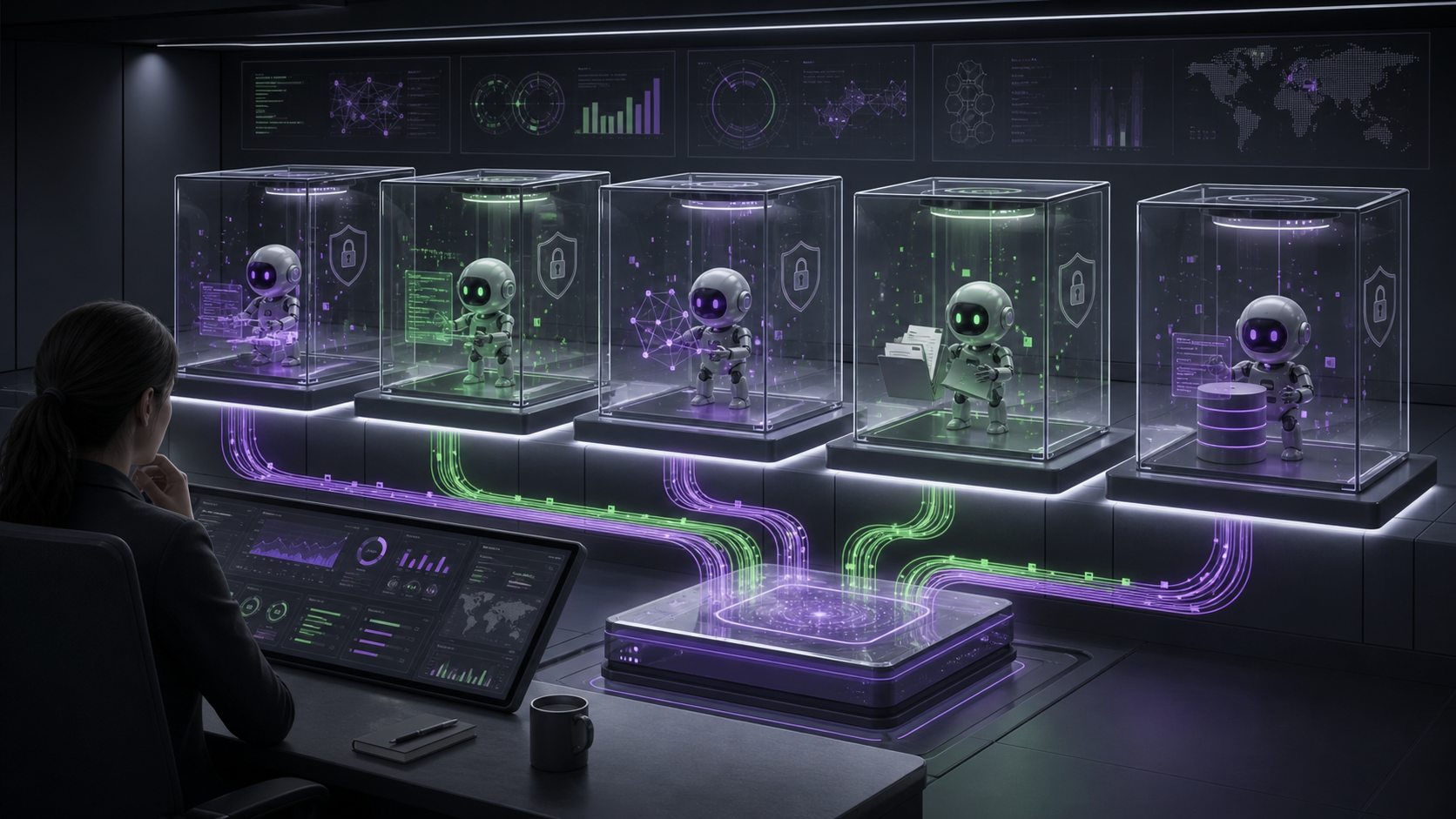
Enterprise AI agents operating inside clearly defined security boundaries
  • AI Agents

Nvidia Builds the Control Layer for Enterprise AI Agents

  • March 19, 2026
  • No comments
Total
0
Shares
0
0
0
0

Nvidia wants to become the infrastructure beneath enterprise AI agents, not only the company supplying the chips on which they run.

The open-source Agent Toolkit, announced at GTC 2026, combines a secure runtime, open models and an agentic research blueprint. Its target is the obstacle slowing production deployment: organisations want agents to act across internal systems but lack a standard way to control data access, policies, cost and liability.

The partner list spans enterprise software, security, engineering and healthcare, suggesting Nvidia is building a common layer rather than a single application.

OpenShell gives autonomous software a boundary

The toolkit’s centrepiece is OpenShell, an open-source runtime that enforces policy-based security and privacy controls. Nvidia calls individual agents “claws”; OpenShell defines the environment in which each one can act.

That boundary is necessary because an agent able to use tools is more consequential than a chatbot generating text. It may access files, change records or trigger workflows. Policies need to state which resources are available, which actions are prohibited and what evidence is retained.

Nvidia is working with Cisco, CrowdStrike, Google, Microsoft Security and TrendAI to integrate OpenShell with existing security products. This acknowledges that agent controls cannot become a separate island. Enterprises already monitor identities, endpoints and threats through established systems.

The runtime does not remove liability, but it can make behaviour more inspectable. Security teams gain a defined enforcement point instead of relying on every agent developer to implement safeguards independently.

AI-Q separates orchestration from research

Nvidia AI-Q, built with LangChain, uses frontier models to orchestrate work and open Nemotron models for research-heavy steps. Nvidia claims the hybrid architecture cuts query cost by more than 50% while leading two DeepResearch Bench leaderboards.

The economic principle is sensible even when benchmark claims require real-world validation. Expensive models need not perform every subtask. Routing repetitive research to a capable lower-cost model can protect budgets as usage grows.

Consumption pricing often looks manageable in pilots because volumes are small. A research agent serving thousands of employees can generate long contexts and many tool calls. Architecture determines whether that scale creates value or an uncontrolled bill.

The toolkit is available across AWS, Google Cloud, Microsoft Azure and Oracle Cloud Infrastructure. Open deployment reduces pressure to adopt one hosting environment while allowing Nvidia’s software layer to remain common.

Enterprise partners turn components into workflows

Salesforce is developing a reference architecture in which Slack orchestrates Agentforce agents across cloud and on-premises data. Atlassian is connecting the toolkit to Rovo in Jira and Confluence, while ServiceNow uses AI-Q in its autonomous specialist strategy.

Siemens’ Fuse EDA agent applies Nemotron to electronic design workflows from conception to manufacturing sign-off. IQVIA says it has already deployed more than 150 agents internally and with clients, including 19 of the world’s 20 largest pharmaceutical companies.

These examples show why a toolkit matters. Each industry needs different tools and policies, but identity, containment, model routing and monitoring recur across deployments.

Nvidia is positioning OpenShell, Nemotron and AI-Q as the agent equivalent of an infrastructure stack. The company benefits whether the visible application comes from Salesforce, Atlassian, Siemens or an internal team.

The open-source strategy may encourage adoption, but enterprises still need to test how policies hold under failure, malicious instructions and integration complexity. A framework is only as strong as its configuration and operational discipline.

The Agent Toolkit’s significance is therefore not that it makes autonomy safe by default. It gives companies a shared place to express control. If agents become a normal workforce layer, that enforcement point could be as important as the models doing the work.

Production trust will ultimately depend on whether those controls remain understandable when many vendors and hundreds of agents share the same environment.
Views: 83
Total
0
Shares
Share 0
Tweet 0
Pin it 0
Share 0
Topics
  • Agents
  • Nemotron
  • Nvidia
  • OpenShell
  • Security
Previous Article
A small network of specialised AI agents sharing a carefully managed compute budget
  • AI Agents

The Economics That Decide Whether Multi-Agent AI Can Scale

  • March 12, 2026
View Post
Next Article
An autonomous agent operating inside visible permissions and human oversight
  • AI Agents

AI Agent Governance Starts Where Autonomous Action Begins

  • April 6, 2026
View Post

Stay Ahead of AI

Get the AI developments that matter, delivered to your inbox.

More AI News
AI-generated conceptual illustration of an unbranded autonomous test sedan with a safety operator, not an actual Pony.ai vehicle or operating service
View Post
  • 3 min
  • Autonomous Vehicles

inDrive’s Kazakhstan Robotaxi Plan Begins With a Feasibility Test

  • October 23, 2026
AI-generated fictional gathering of women learning with laptops, not the real Aged Intelligence Society or its founders
View Post
  • 3 min
  • Work & Society

Aged Intelligence Society Makes AI Learning a Shared Exercise

  • October 23, 2026
AI-generated fictional clinician reviewing abstract diagnostic research materials, not a real patient or clinical trial
View Post
  • 3 min
  • Healthcare & Life Sciences

Microsoft’s New Diagnostic Results Face a Real-World Test

  • October 23, 2026
AI-generated conceptual brass key connecting separate cloud compartments, not an actual network diagram
View Post
  • 3 min
  • Cybersecurity

ConnectWise Incident Shows Why AI Attack Counts Need Context

  • October 23, 2026
AI-generated fictional office team reviewing abstract computer output, not actual Uber employees or premises
View Post
  • 3 min
  • Enterprise & Productivity

Uber Expands ChatGPT Work, With Outcomes Still to Be Measured

  • October 23, 2026
AI-generated conceptual collage of a record connected to blank devices, illustrating distribution through AI agents
View Post
  • 3 min
  • Business & Markets

Spotify Bets on AI Agents as a Distribution Channel

  • October 23, 2026
AI-generated conceptual server illustration showing an intrusion trail predating a protective update, not an actual affected system
View Post
  • 3 min
  • Cybersecurity

AWS Finds PHP Attack Attempts Before Public Disclosure

  • October 22, 2026
AI-generated fictional California technology-company boardroom and campus, not Meta's actual premises
View Post
  • 3 min
  • Big Tech Strategy

Meta Links Its Non-Voting Share Plan to Founder Leadership

  • October 22, 2026

Leave a Reply Cancel reply

Your email address will not be published. Required fields are marked *

Subscribe

Subscribe now to our newsletter

AI Updates
  • About
  • Newsletter
  • Contact
  • Privacy Policy
  • Terms of Use
Artificial Intelligence News

Input your search keywords and press Enter.

Go to mobile version







