AI Updates
  • Latest News
  • Models & Research
    • AGI & Alignment
    • AI Agents
    • Foundation Models
    • Generative AI
    • Open Source AI
    • Research & Papers
    • Rankings & Benchmarks
  • Infrastructure
    • Chips & Semiconductors
    • Cloud & Networking
    • Data Centers & Neoclouds
    • Developer Platforms
    • Quantum Computing
  • Business
    • Big Tech Strategy
    • Mergers & Acquisitions
    • Public Markets
    • Startups & Funding
    • Talent & Leadership
    • Market Analysis
  • Applications
    • Consumer & Creative
    • Cybersecurity
    • Education & Media
    • Enterprise & Productivity
    • Finance & Legal
    • Healthcare & Life Sciences
    • Industry & Manufacturing
    • Science & Discovery
  • Robotics
    • Autonomous Vehicles
    • Drones & Defense
    • Edge AI & Embodied Intelligence
    • Robotics
  • Energy
    • Cooling & Water
    • Efficiency & Emissions
    • Electricity & Power Grids
    • Nuclear & Renewables
  • Policy & Society
    • AI Safety & Security
    • Copyright & Misinformation
    • Geopolitics
    • Privacy & Human Rights
    • Regulation & Government
    • Work & Society
Stay Ahead of AI

Get the AI developments that matter, delivered to your inbox.

Follow AI Updates
Facebook
Twitter
Instagram
  • Home
  • About
  • News
  • Contact
  • Newsletter
0
0
0
AI Updates AI Updates
AI Updates
  • Latest News
  • Models & Research
    • AGI & Alignment
    • AI Agents
    • Foundation Models
    • Generative AI
    • Open Source AI
    • Research & Papers
    • Rankings & Benchmarks
  • Infrastructure
    • Chips & Semiconductors
    • Cloud & Networking
    • Data Centers & Neoclouds
    • Developer Platforms
    • Quantum Computing
  • Business
    • Big Tech Strategy
    • Mergers & Acquisitions
    • Public Markets
    • Startups & Funding
    • Talent & Leadership
    • Market Analysis
  • Applications
    • Consumer & Creative
    • Cybersecurity
    • Education & Media
    • Enterprise & Productivity
    • Finance & Legal
    • Healthcare & Life Sciences
    • Industry & Manufacturing
    • Science & Discovery
  • Robotics
    • Autonomous Vehicles
    • Drones & Defense
    • Edge AI & Embodied Intelligence
    • Robotics
  • Energy
    • Cooling & Water
    • Efficiency & Emissions
    • Electricity & Power Grids
    • Nuclear & Renewables
  • Policy & Society
    • AI Safety & Security
    • Copyright & Misinformation
    • Geopolitics
    • Privacy & Human Rights
    • Regulation & Government
    • Work & Society
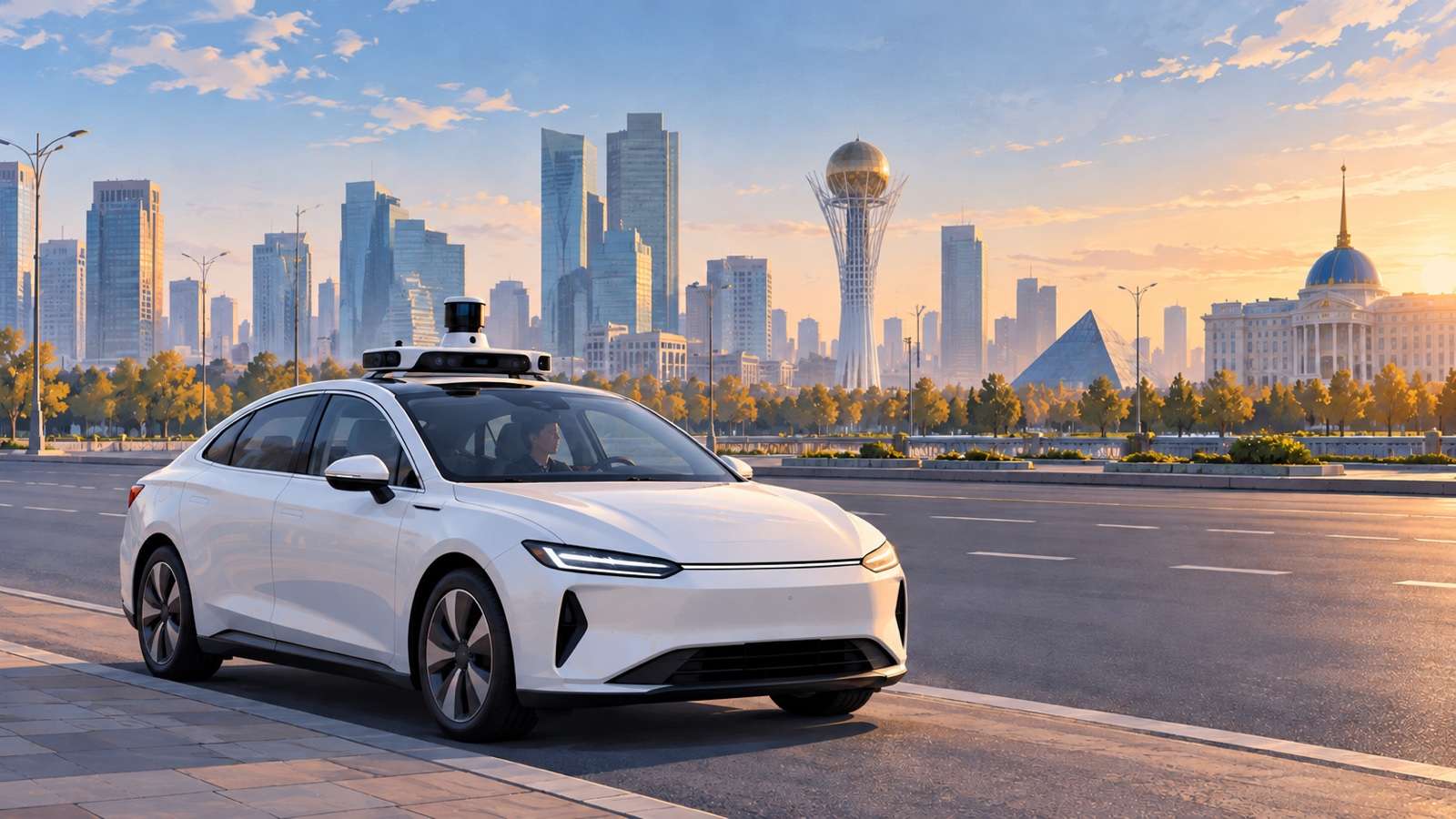
AI-generated conceptual illustration of an unbranded autonomous test sedan with a safety operator, not an actual Pony.ai vehicle or operating service
  • Autonomous Vehicles

inDrive’s Kazakhstan Robotaxi Plan Begins With a Feasibility Test

  • October 23, 2026
  • No comments
Total
0
Shares
0
0
0
0

inDrive’s autonomous-driving ambitions now have a proposed testing ground in Kazakhstan. Pony.ai announced on October 23 that it had signed a memorandum of understanding with the ride-hailing platform and NVIDIA to investigate a service in Astana. The agreement concerns feasibility, not an operating robotaxi network or an unconditional launch commitment. Pony.ai’s announcement sets out the proposed collaboration.

Testing in Astana is targeted for the first half of 2027, with a safety operator initially, inDrive’s CTO told TechCrunch.

A proposed service, with separate responsibilities

The partners have outlined a division of work: Pony.ai would supply its seventh-generation robotaxis, inDrive would provide the booking platform and operate the service, and NVIDIA would contribute AI infrastructure. The assessment covers operational, technical, commercial and regulatory feasibility. Pony.ai says a launch would follow agreement with Kazakhstan’s government; expansion elsewhere would be assessed after Astana. Those are the company’s stated plans, not evidence that local authorization has already been secured. The release does not establish a functioning passenger service.

For passengers, that distinction determines what the announcement actually offers: a project to evaluate, rather than a ride they can book today. For the partners, it separates three questions that should not be collapsed into one. A vehicle can be technically capable, an operator can have a distribution channel, and the proposed service can still need a workable operating model. Success would require those pieces to fit together, not merely to be announced together.

Safety infrastructure is not local performance evidence

The technical context is useful, but it cannot settle the deployment question. NVIDIA’s existing Halos SAFE technical introduction describes safety evaluation as a combination of road testing, simulation and monitoring of deployed fleets. It presents the framework as tools and guidance for generating evidence across different autonomy levels, rather than a single test that establishes safety for every application.

That documentation also explains why a small trial cannot carry the entire argument: sufficiently rare failures demand evidence at a scale that a pre-production fleet cannot accumulate alone. This is NVIDIA’s account of its evaluation approach, not an independent assessment of the proposed Kazakhstan vehicles. It provides background for understanding the partnership, not results from Astana.

A useful future report would therefore connect claims to operating conditions and test methods. What circumstances were evaluated, what required intervention, and what remained outside the assessment? These are questions for subsequent evidence, not allegations of faults. A named safety framework can organize that work; its inclusion in a partnership does not tell readers how the completed service will perform locally.

The harder business question is who owns the transition

inDrive’s broader autonomous-mobility strategy supplies another lens on the project. The company argues that emerging markets should be a priority for autonomy and that existing drivers should have a route to becoming fleet owners and operators. It describes a partnership-led approach built around its platform, operational data and market access, rather than large investments in manufacturing vehicles or owning fleets itself.

That is a statement of strategy, not a published financing package for Astana. The same material identifies local operational knowledge, regulatory relationships and support for pilot deployments as contributions inDrive wants to bring. Its proposition is that distribution and local expertise can complement another company’s driving technology. Whether that arrangement delivers affordable rides or attractive ownership economics remains a question to test, not a result demonstrated by the strategy page.

The owner-operator ambition also changes how progress should be judged. A credible commercial update would explain who funds vehicles, who carries financial risk and how participating drivers would earn income. Those questions follow from the proposed ownership model; they are not disclosed contract terms. The next meaningful milestone is evidence about the service and its economics, alongside the testing timetable—not simply another statement that the partners intend to collaborate.


Views: 14
Total
0
Shares
Share 0
Tweet 0
Pin it 0
Share 0
Topics
  • inDrive
  • Kazakhstan
  • Pony.ai
  • Robotaxis
Previous Article
Illustrative photograph of an unbranded compact sedan in an empty parking lot with cameras and an attentive adult safety observer, representing supervised driving research
  • Autonomous Vehicles

AI Driving Experiment Shows Physical Control While a Parking-Lot Test Reveals Limits

  • October 7, 2026
View Post

Stay Ahead of AI

Get the AI developments that matter, delivered to your inbox.

More AI News
AI-generated fictional gathering of women learning with laptops, not the real Aged Intelligence Society or its founders
View Post
  • 3 min
  • Work & Society

Aged Intelligence Society Makes AI Learning a Shared Exercise

  • October 23, 2026
AI-generated fictional clinician reviewing abstract diagnostic research materials, not a real patient or clinical trial
View Post
  • 3 min
  • Healthcare & Life Sciences

Microsoft’s New Diagnostic Results Face a Real-World Test

  • October 23, 2026
AI-generated conceptual brass key connecting separate cloud compartments, not an actual network diagram
View Post
  • 3 min
  • Cybersecurity

ConnectWise Incident Shows Why AI Attack Counts Need Context

  • October 23, 2026
AI-generated fictional office team reviewing abstract computer output, not actual Uber employees or premises
View Post
  • 3 min
  • Enterprise & Productivity

Uber Expands ChatGPT Work, With Outcomes Still to Be Measured

  • October 23, 2026
AI-generated conceptual collage of a record connected to blank devices, illustrating distribution through AI agents
View Post
  • 3 min
  • Business & Markets

Spotify Bets on AI Agents as a Distribution Channel

  • October 23, 2026
AI-generated conceptual server illustration showing an intrusion trail predating a protective update, not an actual affected system
View Post
  • 3 min
  • Cybersecurity

AWS Finds PHP Attack Attempts Before Public Disclosure

  • October 22, 2026
AI-generated fictional California technology-company boardroom and campus, not Meta's actual premises
View Post
  • 3 min
  • Big Tech Strategy

Meta Links Its Non-Voting Share Plan to Founder Leadership

  • October 22, 2026
AI-generated conceptual paper-cut illustration balancing agent-assisted shopping against computing resources, with no real app interface
View Post
  • 3 min
  • Business & Markets

Meta’s Muse Pitch Leaves Its Unit Economics Unproven

  • October 22, 2026

Leave a Reply Cancel reply

Your email address will not be published. Required fields are marked *

Subscribe

Subscribe now to our newsletter

AI Updates
  • About
  • Newsletter
  • Contact
  • Privacy Policy
  • Terms of Use
Artificial Intelligence News

Input your search keywords and press Enter.

Go to mobile version