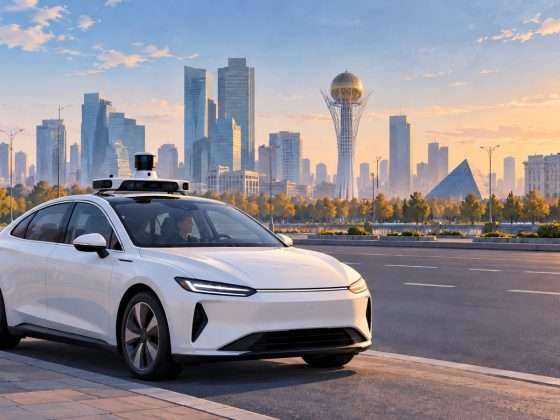
Three AI engineers connected a general-purpose model to a Toyota Corolla and let it slowly navigate a drive-through, with a safety driver ready to brake. WIRED’s account of the experiment offers a striking example of a language-based model acting in the physical world, but a separate parking-lot test exposes how limited that ability remains.
Aditya Ramabadran, Simon Mahns and Tobias Gessler conducted the project outside their work at startup Axiom. Their improvised lunch run used OpenAI’s GPT-6 Astra, cameras and a connection to the vehicle’s steering system. It was an exploratory demonstration, not evidence that a general-purpose chatbot is ready for ordinary road traffic.
A Slow Lunch Run Expands the Test Beyond a Screen
The engineers opened a laptop near a Bay Area In-N-Out restaurant and connected a chat interface to a server linked to windscreen-mounted cameras and the car’s power steering. A human safety driver kept a foot poised above the brake as the model guided the vehicle toward the collection window.
Nothing overtly alarming happened during that short outing, according to WIRED. The engineers nevertheless acknowledged the stakes of letting a general-purpose model influence a heavy moving vehicle. Their precautionary setup is part of the result’s context, not an incidental detail to remove when describing the demonstration.
Unlike conventional self-driving systems specifically engineered and trained for driving, the model was ordinarily used for generating text, code and images. The engineers wanted to investigate whether abilities visible in computer-based tasks could transfer into control of a messy physical environment.
They first tried Grok and subsequently experimented with OpenAI and Anthropic models. Initial responses refused vehicle control, but prompting could elicit more active behavior. That describes what the engineers observed; it does not establish that the systems were intended, validated or approved for driving, or that their responses demonstrated general intelligence.
Parking-Lot Results Show a Narrow and Uneven Capability
The trio’s DrivingBench measures progress around a simple course in a parking lot. In the results reported by WIRED, Astra was the only model to complete the course, and it did so very slowly. Claude Fable 5.1 reached 45 percent of the route, while Grok reached 11 percent.
Those figures are course-completion results from the described experiment, not road-safety statistics. They do not establish performance across traffic, locations or conditions that the article does not test. Even the strongest reported outcome was limited to slowly completing the parking-lot course.
Ramabadran said the models appeared to adapt to the vehicle’s controls and improve as they made mistakes. He interpreted that as adjustment within the interaction. The article reports his observation without independently establishing the mechanism behind it.
The engineers also suspect the capability emerged from training that improved spatial and multimodal reasoning rather than training specifically directed at driving. That remains their explanation of the behavior, not a confirmed account of the model developers’ training decisions. The dramatic demonstration and the modest benchmark results need to be read together.
Physical Reasoning Is a Research Frontier, Not a Settled Milestone
WIRED places the experiment within a broader effort to measure how models understand physical scenes. Andrew Dai, CEO of Elorian AI and a former Google DeepMind researcher, described visual reasoning as important for applications such as robots operating in homes.
Elorian and Scale AI recently developed a separate benchmark called Humanity’s Sixth Sense. Scale AI researcher Xingang Guo said it aims to probe intuitive understanding of scenes rather than perception alone. That benchmark is distinct from DrivingBench; the article does not present its results as validation of the engineers’ driving setup.
The trio’s initial curiosity came from watching models construct complex three-dimensional simulations and wondering whether that translated into real-world navigation. Their experiment gives the question a concrete test, but does not settle how broadly those skills transfer.
The strongest conclusion supported by the report is deliberately limited: a model connected to a vehicle completed a slow, closely supervised task, while related models struggled with a simple course. That is relevant evidence of emerging physical interaction. It is not a demonstrated substitute for a driving system, a safety assessment for public roads or proof that general intelligence has arrived.