

Microsoft, Alphabet and Meta were generating new cloud revenue from artificial intelligence in 2024 while committing extraordinary sums to the hardware, data centres and research needed to stay competitive. The economics of AI had become a contest between compelling potential returns and rapidly increasing development costs.
At the centre of the spending cycle were larger models and the specialised chips used to train them. Ambitions to develop more general systems pushed companies towards bigger clusters, more data and frequent infrastructure upgrades. Even the best-funded groups faced a continuous cycle of investment.
The scale of the required capital could shape not only which companies led AI, but also which organisations were able to participate at all. If frontier development required billions of dollars per model, the market risked becoming concentrated among a small number of technology companies and their partners.
This created a double-edged business case. AI services could attract new cloud customers and revenue, yet each improvement encouraged another round of spending on chips and facilities. Success did not end the investment cycle; it provided a reason to accelerate it.
Competitive pressure made delaying that expenditure difficult for companies seeking leadership.
Nvidia GPUs Became a Major Cost Centre
Nvidia’s H100 accelerator was the industry’s leading chip for training large models and sold for an estimated $30,000, with resellers sometimes asking several times that amount. A global shortage meant some buyers waited months to obtain the hardware.
Meta planned to acquire 350,000 H100 chips by the end of 2024. Even with a volume discount, a fleet of that size represented billions of dollars before accounting for servers, networking, storage or electricity.
The demand strengthened Nvidia’s position while encouraging customers to seek alternatives. Google and Amazon invested in their own AI processors to reduce dependence on third-party suppliers and gain control over performance and cost. Custom silicon could eventually improve economics, but chip design added another expensive research and engineering programme.
Supply constraints compounded the expense. A company unable to obtain accelerators on schedule could delay model training even after committing staff and data to a project. Hardware availability therefore became part of competitive strategy.
Data Centres Added Power, Cooling and Data Costs
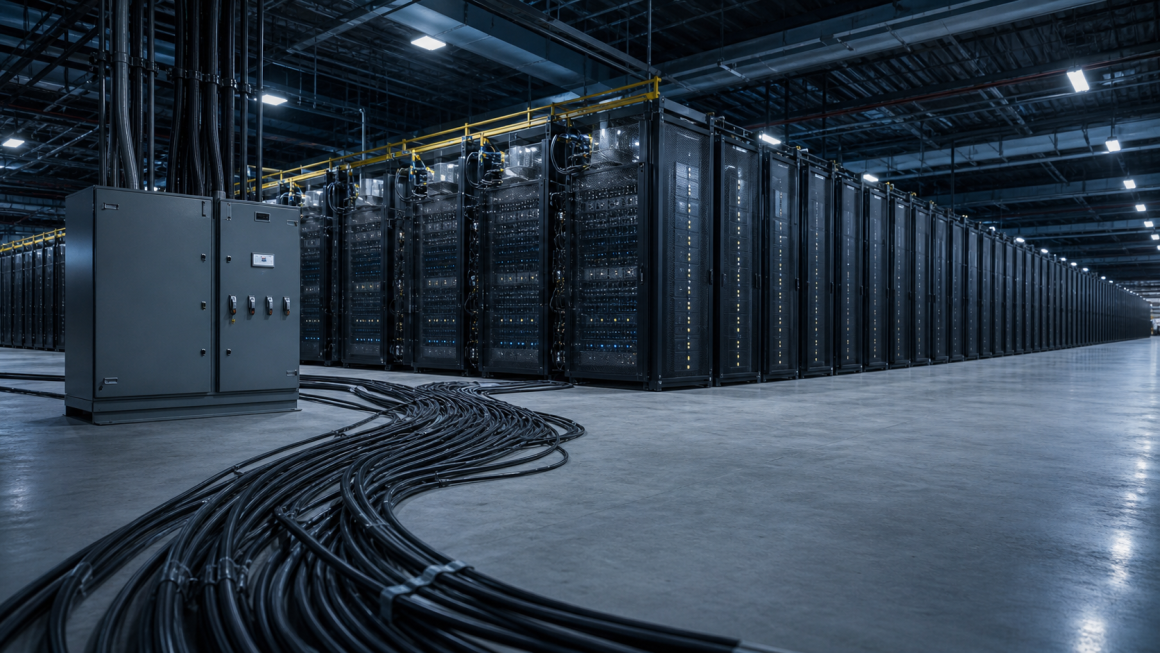
Accelerators operated inside large data centres designed for extreme computational loads. Facilities needed high-capacity networks, cooling systems and dependable electricity, making the cost of AI much broader than the purchase price of a GPU.
As models grew, energy use and heat increased operational expenses and environmental impact. Infrastructure could also become obsolete quickly because the pace of model and chip development forced companies to upgrade systems or retrain models to remain competitive.
Data created another layer of cost. Developers needed large, high-quality datasets and invested in collection, cleaning and annotation. Some also built synthetic-data systems to supplement information drawn from the real world. Each stage required technical staff, tools and controls before training began.
Training Costs Were Approaching Billions
Anthropic CEO Dario Amodei estimated that leading models then available had cost around $100 million to train. He expected models in development for release later in 2024 or early 2025 to approach $1 billion, with costs potentially reaching $5 billion to $10 billion during 2025 and 2026.
Corporate spending reflected that trajectory. Microsoft reported $14 billion in quarterly capital expenditure, 79% more than a year earlier, and expected costs to rise materially in part because of AI infrastructure. Alphabet spent $12 billion, a 91% increase, and expected quarterly expenditure to remain at or above that level.
Meta raised its annual capital-expenditure forecast to between $35 billion and $40 billion. At the top of that range, spending would be 42% higher, driven partly by aggressive investment in AI research and products.
Revenue Potential Kept the Investment Cycle Moving
The spending was not occurring without evidence of demand. Microsoft and Alphabet reported strong growth in their cloud businesses, with AI services identified as an important driver. That revenue helped explain why companies continued investing despite the daunting upfront cost.
The economics still favoured scale. A company able to fund chips, data centres and research could spread the cost across cloud customers and large consumer platforms. Smaller laboratories lacked the same balance sheet and distribution, increasing the risk that frontier development would be limited to a few organisations.
Efficiency research offered one response. Few-shot learning, transfer learning and more efficient model architectures aimed to reduce the compute needed for development and deployment. Edge AI could shift some processing from central data centres to local devices, although that required advances in chips and software optimisation of its own.
The next stage of AI leadership would therefore depend on economic execution as much as algorithmic breakthroughs. A company needed access to hardware, energy, data and capital while finding enough valuable applications to justify the expense.
The cost curve also made efficiency strategically important. A model that achieved comparable results with less compute could be easier to deploy, cheaper to operate and accessible to more organisations. In a market defined by escalating investment, reducing the resources required for useful capability could become as consequential as building the largest system.