

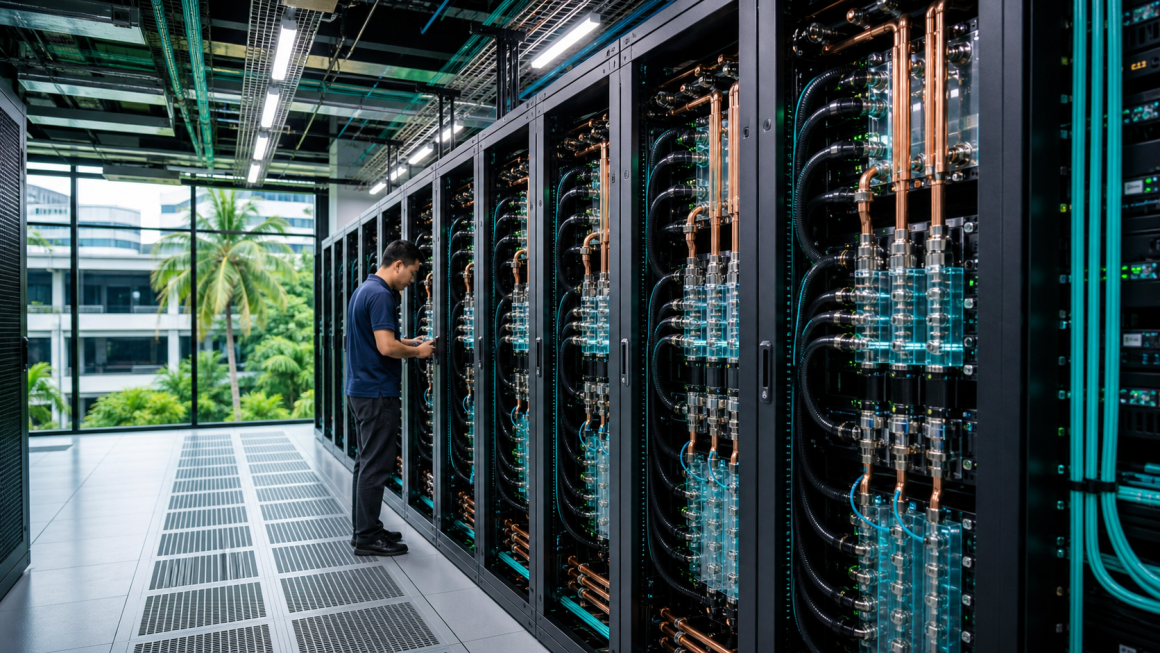
AI infrastructure is forcing data-centre operators to reconsider facilities designed for earlier computing eras. GPU clusters draw and change power rapidly, while their heat density can exceed the reach of conventional air cooling. By 2030, some workloads could push rack power toward one megawatt.
Paul Churchill of Vertiv Asia described a transition from piecemeal upgrades to purpose-built AI factories combining high-capacity electrical systems, advanced thermal management, and scalable modules. The regional market was projected to grow from $236 billion in 2025 to nearly $934 billion by 2030.
The regional picture is not uniform. Mature hubs may face grid and land constraints, while emerging markets may have room to build but less specialised supply and service capacity. Investment decisions should reflect local resilience and environmental conditions instead of copying a reference facility unchanged.
Market Growth Amplifies Infrastructure Pressure
Finance, healthcare, and manufacturing are driving demand for high-performance environments, alongside government digitalisation, 5G, cloud-native applications, and generative AI. The projected market expansion implies rapid construction as well as retrofits across diverse regional climates and grids. Scale makes the surrounding controls more important, since a small error rate can still create substantial operational work when the system handles millions of interactions. Sampling should therefore continue after launch, with high-consequence cases receiving more scrutiny than routine low-risk outputs.
Forecasts should guide scenarios rather than justify every project. Operators can phase capacity against contracted demand and grid readiness, avoiding stranded facilities while preserving room to expand when workloads and hardware roadmaps become clearer. Distributional checks are essential: averages can hide weak performance for a language, location, customer group, or unusual workload. Feedback from people closest to the process should shape the next deployment decision. Publishing known limitations internally also helps users choose when another tool or a human specialist is more appropriate.
Rack Density Outgrows Air Cooling
The source described rack densities rising from roughly 40 kW toward 130 kW and potentially 250 kW by 2030, with extreme future workloads approaching one megawatt. Vertiv is developing hybrid designs that combine direct-to-chip liquid systems with air cooling. The development is best understood as a reallocation of work across software, infrastructure, and people rather than as the removal of human responsibility. Job design and training should change deliberately so staff retain the knowledge needed to recognise and resolve unusual cases.
Liquid cooling can remove heat efficiently at the chip, but it adds pumps, coolant quality, leak management, and specialised service procedures. Facility teams need training, spare capacity, and safe isolation methods before dense racks become ordinary production equipment. The deciding factor is likely to be execution discipline: realistic baselines, clear ownership, routine monitoring, and a workable exit path. Those elements convert an impressive capability into dependable infrastructure. They also give leaders a common language for comparing competing proposals whose marketing claims otherwise use incompatible measures.
Power Delivery Must Follow Dynamic Loads
AI training and inference can change electrical demand quickly, complicating distribution and resilience. High-capacity systems must handle peaks and transitions without compromising other equipment, while integrated monitoring coordinates thermal and power responses. Its value will vary by workload, which makes segmented measurement more useful than a single average drawn from the easiest or most visible use cases. Reporting should include weak segments and abstentions, not only the aggregate that presents the system most favourably.
Nameplate capacity does not reveal grid impact or useful work. Operators should track workload-level energy, peak demand, power quality, and curtailed capacity, then use scheduling and storage where they reduce stress without threatening service commitments. Evaluation should include total operating cost, correction effort, and recovery time alongside speed or benchmark results. Otherwise, apparent efficiency can simply move work to another team or a later stage. Finance and operations should agree the calculation so favourable activity measures do not substitute for realised value.
Modular Design Supports Regional Expansion
Purpose-built AI facilities can use repeatable power and cooling modules that expand as demand grows. This is particularly relevant across Asia Pacific, where site constraints, electricity mixes, temperatures, regulation, and access to engineering skills vary widely. What appears to be one product decision is consequently a chain of choices about data access, integration, monitoring, escalation, and long-term maintenance. Mapping those choices early gives decision-makers a realistic budget and reveals where a reversible trial is preferable to a broad commitment.
A standard module still needs local adaptation. Water availability, heat rejection, seismic risk, supply chains, and community expectations should shape site design, and sustainability claims should account for both operational energy and the equipment’s construction footprint. Human review should be concentrated where consequences are highest rather than added as a ceremonial final click. Reviewers need context, authority, and enough time to recognise when automation has crossed a boundary. Their corrections should improve rules and tests, turning oversight into an active learning mechanism instead of hidden rework.
Useful transparency means explaining limitations and recourse, not exposing sensitive implementation detail that would make abuse easier or systems less secure. Asia-Pacific’s AI capacity will be constrained by physical systems long before demand for models disappears. Operators that coordinate compute plans with grids, water, cooling, maintenance, and local communities will be better positioned than those pursuing density as an isolated engineering target.