AI Updates
  • Latest News
  • Models & Research
    • AGI & Alignment
    • AI Agents
    • Foundation Models
    • Generative AI
    • Open Source AI
    • Research & Papers
    • Rankings & Benchmarks
  • Infrastructure
    • Chips & Semiconductors
    • Cloud & Networking
    • Data Centers & Neoclouds
    • Developer Platforms
    • Quantum Computing
  • Business
    • Big Tech Strategy
    • Mergers & Acquisitions
    • Public Markets
    • Startups & Funding
    • Talent & Leadership
    • Market Analysis
  • Applications
    • Consumer & Creative
    • Cybersecurity
    • Education & Media
    • Enterprise & Productivity
    • Finance & Legal
    • Healthcare & Life Sciences
    • Industry & Manufacturing
    • Science & Discovery
  • Robotics
    • Autonomous Vehicles
    • Drones & Defense
    • Edge AI & Embodied Intelligence
    • Robotics
  • Energy
    • Cooling & Water
    • Efficiency & Emissions
    • Electricity & Power Grids
    • Nuclear & Renewables
  • Policy & Society
    • AI Safety & Security
    • Copyright & Misinformation
    • Geopolitics
    • Privacy & Human Rights
    • Regulation & Government
    • Work & Society
Stay Ahead of AI

Get the AI developments that matter, delivered to your inbox.

Follow AI Updates
Facebook
Twitter
Instagram
  • Home
  • About
  • News
  • Contact
  • Newsletter
0
0
0
AI Updates AI Updates
AI Updates
  • Latest News
  • Models & Research
    • AGI & Alignment
    • AI Agents
    • Foundation Models
    • Generative AI
    • Open Source AI
    • Research & Papers
    • Rankings & Benchmarks
  • Infrastructure
    • Chips & Semiconductors
    • Cloud & Networking
    • Data Centers & Neoclouds
    • Developer Platforms
    • Quantum Computing
  • Business
    • Big Tech Strategy
    • Mergers & Acquisitions
    • Public Markets
    • Startups & Funding
    • Talent & Leadership
    • Market Analysis
  • Applications
    • Consumer & Creative
    • Cybersecurity
    • Education & Media
    • Enterprise & Productivity
    • Finance & Legal
    • Healthcare & Life Sciences
    • Industry & Manufacturing
    • Science & Discovery
  • Robotics
    • Autonomous Vehicles
    • Drones & Defense
    • Edge AI & Embodied Intelligence
    • Robotics
  • Energy
    • Cooling & Water
    • Efficiency & Emissions
    • Electricity & Power Grids
    • Nuclear & Renewables
  • Policy & Society
    • AI Safety & Security
    • Copyright & Misinformation
    • Geopolitics
    • Privacy & Human Rights
    • Regulation & Government
    • Work & Society
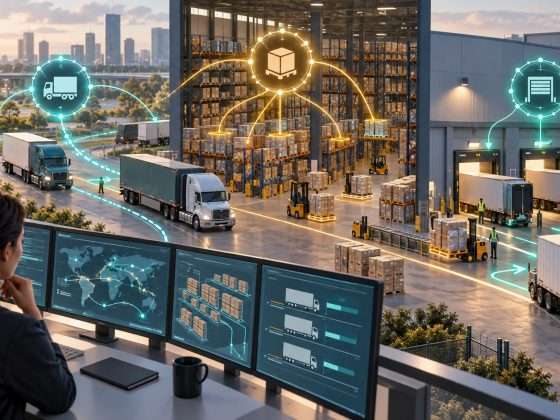
A supply-chain control room where an AI agent moves a delayed shipment from alert to authorized action
  • AI Agents

Supply Chain AI Still Sees Faster Than It Acts

  • September 11, 2026
  • No comments
Total
0
Shares
0
0
0
0

Supply-chain software can identify a disruption long before a company is ready to respond. A new AI News analysis argues that this gap between detection and action, rather than a shortage of predictive models, is where much of the remaining financial damage accumulates.

The article cites the J.S. Held Global Risk Report’s estimate that supply-chain disruption cost businesses about $184 billion in 2025. It presents that figure as evidence of an operating-model problem: alerts arrive sooner, but commercial decisions still wait in human queues.

Visibility Improved Before Execution Did

Control towers, risk scores, digital twins and exception dashboards have shortened the time between an event and awareness of it. Supply-chain teams use AI for demand sensing, estimated arrival times, supplier-risk scoring, inventory optimization and lane analysis. These tools can flag a vessel delay or supplier outage before the consequences reach a customer.

The unresolved work starts after the alert. A planner may still need to decide whether to expedite a shipment, split an order, retender a transport lane, consolidate loads or switch selected products from ocean to air. Those actions affect money, contracts and service levels, so companies commonly place them behind approval steps.

A 2026 Knosc survey cited in the article found that supply-chain teams at mid-market manufacturers and distributors spend 28% of their working time responding to disruption, largely investigating what happened. Capgemini research from 2025 found that 70% of large-company executives ranked an AI-driven next-generation supply chain among their three leading technology trends. Yet Gartner reported that only 23% of supply-chain organizations had a formal AI strategy that year.

Bounded Authority Is the Proposed Change

The analysis argues for agents that can perform narrowly authorized actions instead of producing another recommendation. Examples include retendering a lane when a carrier’s arrival estimate crosses a threshold, consolidating outbound loads before a cutoff or moving safety stock between distribution centres when specific conditions align.

Under this model, each action would be constrained by a policy: approved suppliers, rate bands, product categories, service classes and spending limits. Cases outside the defined boundary would return to a person. The article compares that approach with industrial controls that let machines operate inside an interlock while escalating exceptions.

This is a proposal, not a documented result from a particular deployment. FourKites and ABI Research reported in 2025 that 52% of organizations limited AI to decision support, while only 27% allowed it to act autonomously. Those figures show how uncommon delegated execution remains; they do not establish the savings an agent would deliver.

Systems and Accountability Must Change Together

Three practical barriers stand between alerts and agent action. First, operating decisions must be written as explicit policies rather than remaining in an experienced planner’s memory. Companies need to identify which moves are reversible, which require hard spending caps and which suppliers or modes are already cleared.

Second, transaction systems must accept authenticated machine activity. An agent that drafts a request for quotation but cannot submit it is still only an advisory tool. Transport, warehouse and sourcing platforms would need to log each action and support reversal when a decision goes wrong.

Third, accountability must attach to the policy, data and authorization boundary. If staff are punished for every permitted automated action that fails, organizations have an incentive to make agents wait for approval and recreate the original delay.

The article predicts that companies granting bounded authority will respond faster and reduce cost, but it supplies no controlled comparison, implementation budget or measured return. Its stronger point is diagnostic: AI investment has often optimized observation while leaving execution untouched. Whether agents close that gap will depend less on fluent recommendations than on the contracts, system permissions and governance that let software make a limited commercial move.

Views: 135
Total
0
Shares
Share 0
Tweet 0
Pin it 0
Share 0
Topics
  • AI Agents
  • Automation
  • Logistics
  • Supply Chains
Previous Article
A consumer approves an AI action inside an isolated virtual machine protected by a security filter
  • AI Agents

Meta’s Muse Agent Puts Consumer Trust Inside the Architecture

  • September 9, 2026
View Post
Next Article
Specialized AI agents coordinating freight, inventory and warehouse operations across a luminous supply network
  • AI Agents

Multi-Agent AI Moves Supply Chains From Advice to Execution

  • September 21, 2026
View Post

Stay Ahead of AI

Get the AI developments that matter, delivered to your inbox.

More AI News
AI-generated conceptual illustration of an unbranded autonomous test sedan with a safety operator, not an actual Pony.ai vehicle or operating service
View Post
  • 3 min
  • Autonomous Vehicles

inDrive’s Kazakhstan Robotaxi Plan Begins With a Feasibility Test

  • October 23, 2026
AI-generated fictional gathering of women learning with laptops, not the real Aged Intelligence Society or its founders
View Post
  • 3 min
  • Work & Society

Aged Intelligence Society Makes AI Learning a Shared Exercise

  • October 23, 2026
AI-generated fictional clinician reviewing abstract diagnostic research materials, not a real patient or clinical trial
View Post
  • 3 min
  • Healthcare & Life Sciences

Microsoft’s New Diagnostic Results Face a Real-World Test

  • October 23, 2026
AI-generated conceptual brass key connecting separate cloud compartments, not an actual network diagram
View Post
  • 3 min
  • Cybersecurity

ConnectWise Incident Shows Why AI Attack Counts Need Context

  • October 23, 2026
AI-generated fictional office team reviewing abstract computer output, not actual Uber employees or premises
View Post
  • 3 min
  • Enterprise & Productivity

Uber Expands ChatGPT Work, With Outcomes Still to Be Measured

  • October 23, 2026
AI-generated conceptual collage of a record connected to blank devices, illustrating distribution through AI agents
View Post
  • 3 min
  • Business & Markets

Spotify Bets on AI Agents as a Distribution Channel

  • October 23, 2026
AI-generated conceptual server illustration showing an intrusion trail predating a protective update, not an actual affected system
View Post
  • 3 min
  • Cybersecurity

AWS Finds PHP Attack Attempts Before Public Disclosure

  • October 22, 2026
AI-generated fictional California technology-company boardroom and campus, not Meta's actual premises
View Post
  • 3 min
  • Big Tech Strategy

Meta Links Its Non-Voting Share Plan to Founder Leadership

  • October 22, 2026

Leave a Reply Cancel reply

Your email address will not be published. Required fields are marked *

Subscribe

Subscribe now to our newsletter

AI Updates
  • About
  • Newsletter
  • Contact
  • Privacy Policy
  • Terms of Use
Artificial Intelligence News

Input your search keywords and press Enter.

Go to mobile version







