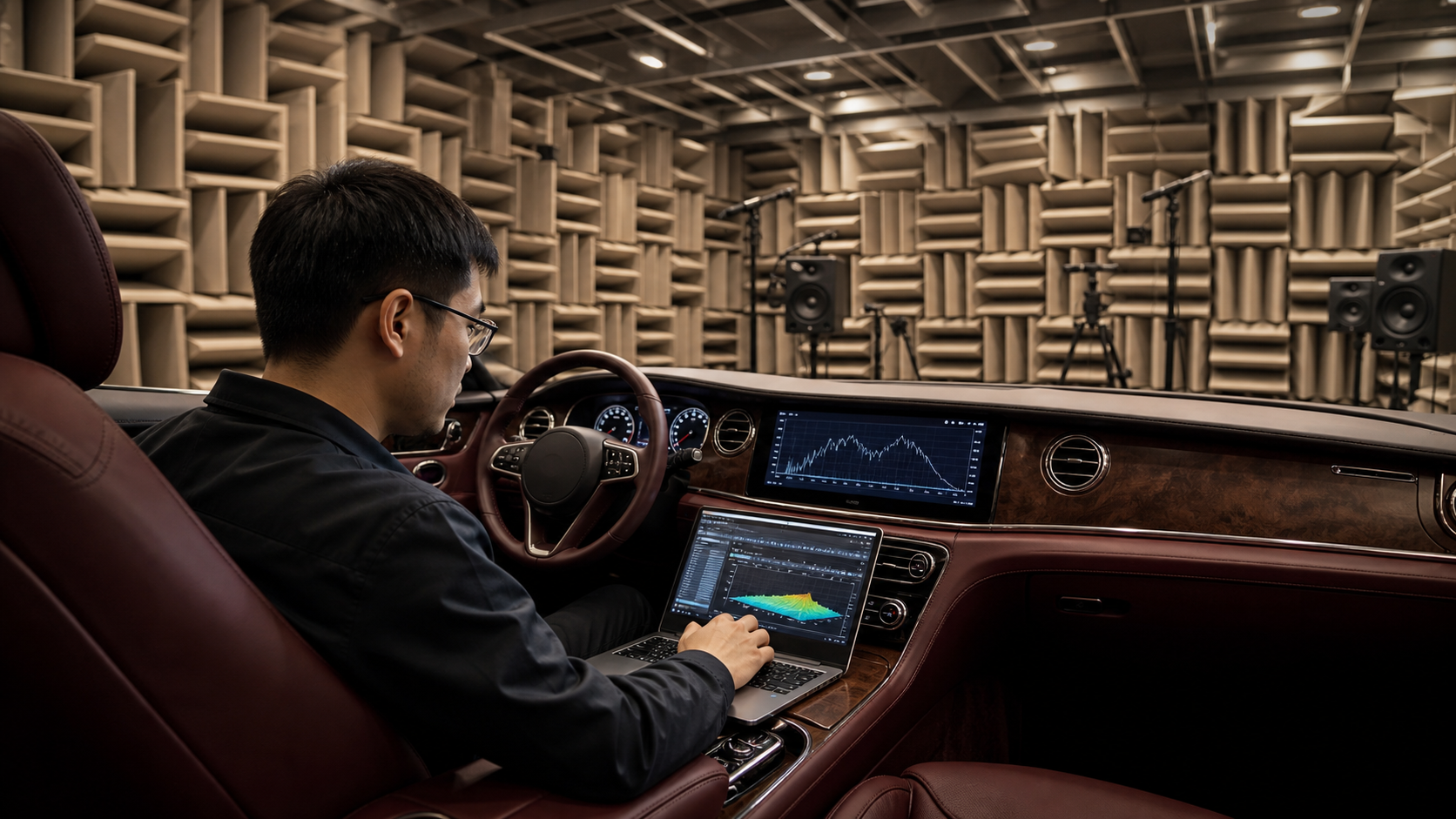
Huawei’s Shanghai Acoustics R&D Centre looks less like a consumer-electronics showroom than a serious audio engineering programme. The facility contains an anechoic chamber, a larger semi-anechoic room, and a 9.1.6 listening space built to measure and tune sound under controlled conditions.
The work feeds the HUAWEI SOUND ULTIMATE system in the Maextro S800 electric sedan. Its 43 speakers, dual amplifiers, tactile exciters, spatial channels, independent sound zones, and HarmonyOS integration show how software, psychoacoustics, and mechanical design are converging inside premium vehicles.
Automotive audio is a revealing example of embodied computing because the final experience depends on software, sensors, cabin geometry, materials, speakers, and human perception. Improvements cannot be assessed on a processor benchmark alone; they must survive movement, noise, different seating positions, and years of vehicle use.
Measurement and Listening Shape the Tuning
The process begins with frequency response, phase, timing, and distortion measurements, then moves into subjective listening informed by psychoacoustics. Engineers compensate for asymmetric seating, close reflections, and cabin bass effects while aiming to preserve the recording’s intended character. That distinction matters because the headline capability depends on the less visible work of moving, checking, and interpreting information before a useful output reaches anyone. Tracking that chain shows whether latency has genuinely fallen or has merely been transferred to preparation and review.
Objective data and trained listening answer different questions, so neither should substitute for the other. Evaluation should include varied music, speech, seats, road surfaces, and listener preferences rather than optimising a spectacular demonstration track. Security and governance work best when designed into the workflow, with access limits, logs, and clear escalation paths. Retrofitting them after adoption usually leaves blind spots and unclear accountability. Routine access reviews and incident exercises can show whether written controls remain usable under time pressure.
The Ultimate Series Uses Purpose-Built Hardware
The Maextro S800 system delivers 2,920 watts through 43 speakers. A tangential-force woofer changes door-driver geometry to reduce panel resonance, while a dual-diaphragm subwoofer uses cabin volume and a rising diffuser improves central image consistency. The figures describe an announced or observed position at publication time, so deployment quality and repeatable results remain more informative than the scale of the claim alone. Later evaluation should preserve the original assumptions instead of silently judging the proposal against information unavailable when it was made.
Novel components create value only if they remain reliable, serviceable, and well integrated with vehicle structures. Production tolerances and cabin materials can alter acoustics, making calibration and quality control as important as the design of a flagship prototype. A phased approach creates evidence while keeping reversal affordable. It also gives teams time to strengthen data quality and operating skills before additional autonomy increases the consequences of a mistake. Expansion gates should be tied to performance and readiness, not simply to a date promised in an initial roadmap.
Independent Zones Separate Passenger Experiences
Four headrests each contain tweeters and midrange drivers, while sound-field algorithms use the main array for active suppression between rows. Huawei claims up to 30 dB isolation and 99 percent energy separation, allowing passengers to hear different content. Seen operationally, the change touches architecture, staffing, procurement, and support at the same time; it cannot be evaluated as a model upgrade in isolation. Each affected team needs a defined role before launch, particularly when a fault crosses organisational or supplier boundaries.
The demonstration showed limited crosstalk between classical music and an action film, although performance across volume levels and material still needs real-world testing. Comfort, intelligibility, and driver distraction should join acoustic isolation in the acceptance criteria. A credible rollout would define a baseline, track exceptions, and name the person empowered to pause or narrow the system. That makes improvement visible without treating early momentum as proof that every use case should expand. Review dates should be agreed before enthusiasm or sunk cost makes a later decision unnecessarily difficult.
AI Links Sound With the Wider Cabin
HarmonyOS supports spatial positioning and sound-to-light ambient effects that respond to music, while road-noise cancellation uses a multi-channel, low-latency model. Passive acoustic glass and absorptive materials complement the active system. The source therefore points to a system-level change in which interfaces and operating practices are just as consequential as raw technical performance. Compatibility, documentation, and recovery procedures determine whether that performance remains available during ordinary work.
Responsive lighting and cancellation can make the cabin feel coherent, but personalisation should remain controllable and predictable. Drivers need simple overrides, privacy around profiles, and assurance that software updates will not unexpectedly alter safety-relevant alerts or audio balance. Teams also need version records and representative tests, because data, models, user behaviour, and external rules will not remain fixed. A result that cannot be reproduced is a weak basis for an enduring process. Change logs should connect each release to observed gains, regressions, incidents, and any revised operating limits.
Procurement terms should support audit, data export, incident assistance, and orderly transition so accountability survives changes in technology or supplier. Huawei has demonstrated an ambitious technical foundation and recruited expertise from established audio companies. Commercial success will depend on carrying that precision into repeatable production across vehicles and persuading customers that advanced sound zones and tactile features justify their cost.