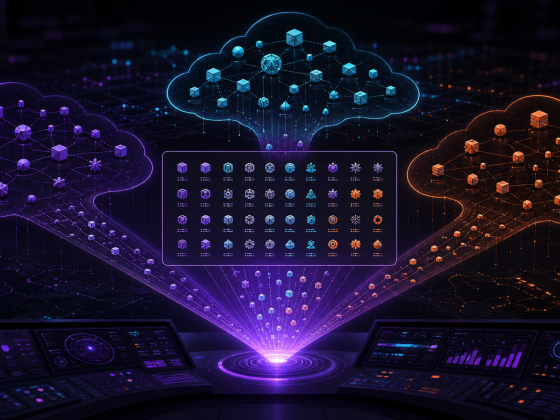
Databricks telemetry suggests enterprise AI is moving from isolated assistants toward systems that coordinate several models and tools. Across more than 20,000 organisations, including 60 percent of the Fortune 500, multi-agent workflow use grew 327 percent between June and October 2025.
The rapid increase does not mean autonomous digital companies have arrived. The leading pattern is the Supervisor Agent: an orchestrator that breaks a request into parts and routes each part to a specialised agent or tool.
Enterprise adoption is becoming less about one model answering everything and more about designing a controlled system around division of labour.
Supervisor Agents Organise Specialised Work
Since its July 2025 launch, Databricks’ Supervisor Agent grew to 37 percent of agent usage by October. It can detect intent, apply compliance checks, and delegate work rather than stretching one model across every domain.
The pattern resembles a manager coordinating people with different skills. In financial services, one agent might retrieve documents while another checks regulatory requirements and a supervisor assembles the verified response. The design can improve modularity and let teams test each function separately.
It also creates new failure paths. The supervisor may route incorrectly, context can be lost between agents, and one compromised component can influence the chain. Every handoff needs an identity, permission boundary, trace, and rule for what happens when agents disagree.
Technology companies currently build nearly four times more multi-agent systems than any other industry. Their early lead may reflect stronger engineering capacity rather than universal readiness for the architecture.
Agents Are Reshaping the Data Layer
Databricks reports that two years ago agents created 0.1 percent of databases; the figure is now 80 percent on its platform. AI agents also create 97 percent of database testing and development environments.
These numbers show how automation changes workload assumptions. Agents generate frequent reads and writes, create temporary environments, test code, and remove resources at a pace conventional human-operated systems were not designed to expect.
Infrastructure must handle bursts, rapid schema changes, cost limits, and automatic cleanup. An agent that can create a database also needs rules preventing abandoned environments, uncontrolled copies of sensitive data, or a runaway loop.
Real-time inference dominates, accounting for 96 percent of requests. Technology processes 32 real-time requests for every batch request, while healthcare and life sciences report a 13-to-one ratio. Serving infrastructure therefore becomes part of user experience and operational reliability.
Governance Correlates With Faster Production
The most useful finding challenges the idea that controls only delay AI. Organisations using governance tools place more than 12 times as many AI projects into production, while those using evaluation tools achieve nearly six times more deployments.
The relationship does not prove that buying a governance product causes success. More mature organisations may invest in both controls and delivery. The mechanism is still credible: stakeholders approve systems more readily when data use, rate limits, quality, and failure handling are visible.
Companies are also reducing model dependency. By October 2025, 78 percent used at least two model families, and the share using three or more rose from 36 to 59 percent between August and October. Different work can be routed to cheaper, specialised, open, or frontier models.
Multi-model flexibility needs real portability. Evaluation sets, prompts, data access, and workflow logic should remain separable from a provider; otherwise a catalogue of models can conceal dependence on the surrounding platform.
Current value remains practical. Predictive maintenance represents 35 percent of manufacturing and automotive use cases, medical literature synthesis accounts for 23 percent in health and life sciences, and market intelligence makes up 14 percent in retail. Customer support, advocacy, and onboarding form 40 percent of leading cases.
The agentic shift is therefore both ambitious and ordinary. Systems are gaining the ability to coordinate actions, but they earn adoption through bounded work with measurable outcomes. The enterprises advancing fastest appear to be those treating orchestration, evaluation, permissions, and infrastructure as the product—not as accessories around a clever model.