AI Updates
  • Latest News
  • Models & Research
    • AGI & Alignment
    • AI Agents
    • Foundation Models
    • Generative AI
    • Open Source AI
    • Research & Papers
    • Rankings & Benchmarks
  • Infrastructure
    • Chips & Semiconductors
    • Cloud & Networking
    • Data Centers & Neoclouds
    • Developer Platforms
    • Quantum Computing
  • Business
    • Big Tech Strategy
    • Mergers & Acquisitions
    • Public Markets
    • Startups & Funding
    • Talent & Leadership
    • Market Analysis
  • Applications
    • Consumer & Creative
    • Cybersecurity
    • Education & Media
    • Enterprise & Productivity
    • Finance & Legal
    • Healthcare & Life Sciences
    • Industry & Manufacturing
    • Science & Discovery
  • Robotics
    • Autonomous Vehicles
    • Drones & Defense
    • Edge AI & Embodied Intelligence
    • Robotics
  • Energy
    • Cooling & Water
    • Efficiency & Emissions
    • Electricity & Power Grids
    • Nuclear & Renewables
  • Policy & Society
    • AI Safety & Security
    • Copyright & Misinformation
    • Geopolitics
    • Privacy & Human Rights
    • Regulation & Government
    • Work & Society
Stay Ahead of AI

Get the AI developments that matter, delivered to your inbox.

Follow AI Updates
Facebook
Twitter
Instagram
  • Home
  • About
  • News
  • Contact
  • Newsletter
0
0
0
AI Updates AI Updates
AI Updates
  • Latest News
  • Models & Research
    • AGI & Alignment
    • AI Agents
    • Foundation Models
    • Generative AI
    • Open Source AI
    • Research & Papers
    • Rankings & Benchmarks
  • Infrastructure
    • Chips & Semiconductors
    • Cloud & Networking
    • Data Centers & Neoclouds
    • Developer Platforms
    • Quantum Computing
  • Business
    • Big Tech Strategy
    • Mergers & Acquisitions
    • Public Markets
    • Startups & Funding
    • Talent & Leadership
    • Market Analysis
  • Applications
    • Consumer & Creative
    • Cybersecurity
    • Education & Media
    • Enterprise & Productivity
    • Finance & Legal
    • Healthcare & Life Sciences
    • Industry & Manufacturing
    • Science & Discovery
  • Robotics
    • Autonomous Vehicles
    • Drones & Defense
    • Edge AI & Embodied Intelligence
    • Robotics
  • Energy
    • Cooling & Water
    • Efficiency & Emissions
    • Electricity & Power Grids
    • Nuclear & Renewables
  • Policy & Society
    • AI Safety & Security
    • Copyright & Misinformation
    • Geopolitics
    • Privacy & Human Rights
    • Regulation & Government
    • Work & Society
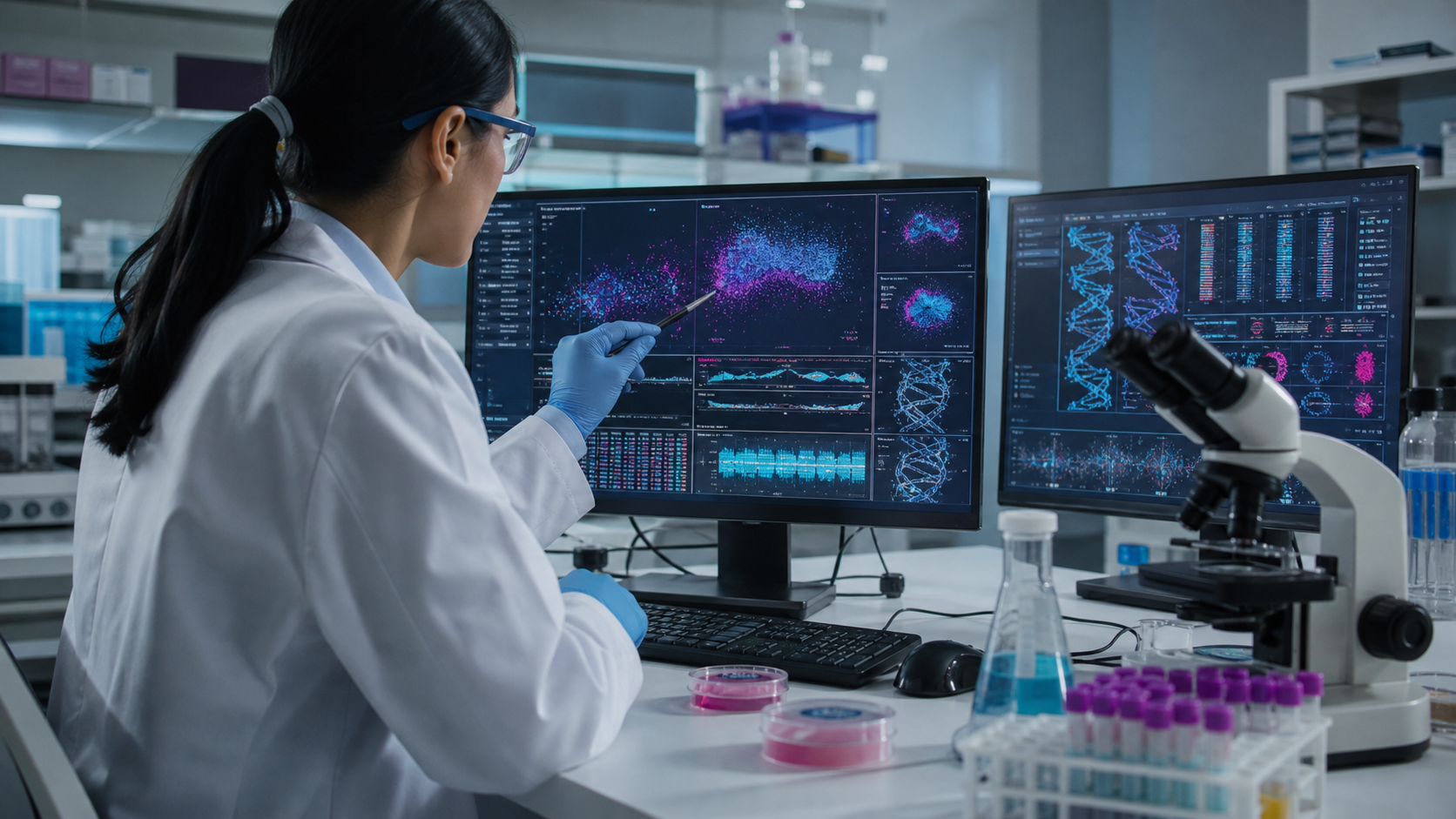
Life-science researcher guiding accelerated genomic and molecular analysis from a laboratory workstation
  • Science & Discovery

Claude Science Connects Natural Language to NVIDIA BioNeMo Workflows

  • July 2, 2026
  • No comments
Total
0
Shares
0
0
0
0

Anthropic’s public beta of Claude Science integrates NVIDIA’s BioNeMo Agent Toolkit, allowing researchers to describe a scientific task in natural language and invoke specialised computational models, libraries and microservices.

The combination aims to remove configuration friction from genomics, proteomics, single-cell analysis and molecular design. Its value depends on whether faster computation remains traceable to correct inputs, tools and scientific assumptions.

Agents translate research intent into specialised execution

A scientist can request sequence analysis, protein prediction or molecular-binder design. Claude Science selects an appropriate BioNeMo skill, formats inputs, runs it on accelerated infrastructure and returns output for review.

The toolkit describes each tool’s purpose and required data, helping the agent choose rather than treating every problem as a general language task. Models such as Evo 2, Boltz-2 and OpenFold3 cover different biomolecular stages.

A cancer workflow might identify a mutation, generate potential inhibitors, fingerprint compounds, build conformers and compare biological response before proposing laboratory experiments.

The agent should expose the selected method, parameters and versions. A natural-language interface must not hide choices that a computational scientist would ordinarily inspect.

Acceleration changes the rhythm of scientific reasoning

NVIDIA reports that Parabricks can reduce genomic analysis from hours to minutes. RAPIDS-singlecell reportedly cut preprocessing and clustering of 1.3 million cells from 52 minutes to 25 seconds, while nvMolKit accelerates some chemistry operations dramatically.

When results return quickly, analysis can become part of an interactive reasoning loop rather than an overnight batch. Scientists can inspect output, refine a hypothesis and test again while the question is still active.

Speed may also encourage excessive exploration and multiple-comparison errors. Teams need predefined evaluation and correction for the number of hypotheses tested.

Computational predictions remain inputs to experiments. A plausible structure or molecule must survive physical validation, toxicity, manufacturability and clinical evidence.

Benchmark acceleration should be reported with hardware, dataset and preprocessing assumptions. A dramatic speedup can reflect a highly optimised workload that differs from a laboratory’s actual data. Researchers should run representative pilots and confirm that numerical results remain equivalent to trusted baselines before making the accelerated path standard.

Resource usage should be visible. An easy conversational request can launch costly GPU work, so budgets and queues need the same clarity as laboratory equipment scheduling.

Education is another benefit. Scientists who are not infrastructure specialists can explore advanced tools, but the interface should teach enough method to prevent blind use. Explanations of input constraints and failure modes make accessibility compatible with rigour.

Stable microservices can make workflows portable and auditable

BioNeMo NIM packages models as containerised inference services behind stable APIs. The toolkit is described as open and harness-agnostic, allowing the same skills to work across agent frameworks.

That modularity can reduce lock-in and let teams replace a model without rebuilding the whole interface. Compatibility should be tested against validated pipelines before a new version enters regulated work.

Research data requires strict access, retention and provenance. Agent logs should link source datasets, generated code, computational environment and human interpretation.

The public beta gives scientists an opportunity to request missing integrations and domain specialists. Feedback should include failure cases, not only successful demonstrations.

BioNeMo is already used by many large pharmaceutical companies, while Claude Science supplies a more accessible coordination layer. The integration could broaden who can operate complex computational pipelines without eliminating the need for domain expertise.

Natural language is valuable when it lets scientists focus on questions rather than endpoints. It becomes dangerous when conversational ease obscures method. The strongest research workbench will make advanced computation easier to call while making evidence, uncertainty and reproducibility even harder to overlook.

It should also make computational provenance easier to inspect than today’s manually assembled pipelines.


Views: 120
Total
0
Shares
Share 0
Tweet 0
Pin it 0
Share 0
Topics
  • BioNeMo
  • Claude
  • LifeSciences
  • Nvidia
  • Research
Previous Article
Research team organising evidence and funding opportunities around a clear proposal plan
  • Science & Discovery

AI Grant Tools Are Moving From Drafting to Funding Strategy

  • June 1, 2026
View Post
Next Article
A hurricane viewed from above with layered atmospheric forecast paths approaching a coastline
  • Science & Discovery

WeatherNext Could Add a Critical Day to Hurricane Warnings

  • August 6, 2026
View Post

Stay Ahead of AI

Get the AI developments that matter, delivered to your inbox.

More AI News
AI-generated conceptual illustration of an unbranded autonomous test sedan with a safety operator, not an actual Pony.ai vehicle or operating service
View Post
  • 3 min
  • Autonomous Vehicles

inDrive’s Kazakhstan Robotaxi Plan Begins With a Feasibility Test

  • October 23, 2026
AI-generated fictional gathering of women learning with laptops, not the real Aged Intelligence Society or its founders
View Post
  • 3 min
  • Work & Society

Aged Intelligence Society Makes AI Learning a Shared Exercise

  • October 23, 2026
AI-generated fictional clinician reviewing abstract diagnostic research materials, not a real patient or clinical trial
View Post
  • 3 min
  • Healthcare & Life Sciences

Microsoft’s New Diagnostic Results Face a Real-World Test

  • October 23, 2026
AI-generated conceptual brass key connecting separate cloud compartments, not an actual network diagram
View Post
  • 3 min
  • Cybersecurity

ConnectWise Incident Shows Why AI Attack Counts Need Context

  • October 23, 2026
AI-generated fictional office team reviewing abstract computer output, not actual Uber employees or premises
View Post
  • 3 min
  • Enterprise & Productivity

Uber Expands ChatGPT Work, With Outcomes Still to Be Measured

  • October 23, 2026
AI-generated conceptual collage of a record connected to blank devices, illustrating distribution through AI agents
View Post
  • 3 min
  • Business & Markets

Spotify Bets on AI Agents as a Distribution Channel

  • October 23, 2026
AI-generated conceptual server illustration showing an intrusion trail predating a protective update, not an actual affected system
View Post
  • 3 min
  • Cybersecurity

AWS Finds PHP Attack Attempts Before Public Disclosure

  • October 22, 2026
AI-generated fictional California technology-company boardroom and campus, not Meta's actual premises
View Post
  • 3 min
  • Big Tech Strategy

Meta Links Its Non-Voting Share Plan to Founder Leadership

  • October 22, 2026

Leave a Reply Cancel reply

Your email address will not be published. Required fields are marked *

Subscribe

Subscribe now to our newsletter

AI Updates
  • About
  • Newsletter
  • Contact
  • Privacy Policy
  • Terms of Use
Artificial Intelligence News

Input your search keywords and press Enter.

Go to mobile version







