AI Updates
  • Latest News
  • Models & Research
    • AGI & Alignment
    • AI Agents
    • Foundation Models
    • Generative AI
    • Open Source AI
    • Research & Papers
    • Rankings & Benchmarks
  • Infrastructure
    • Chips & Semiconductors
    • Cloud & Networking
    • Data Centers & Neoclouds
    • Developer Platforms
    • Quantum Computing
  • Business
    • Big Tech Strategy
    • Mergers & Acquisitions
    • Public Markets
    • Startups & Funding
    • Talent & Leadership
    • Market Analysis
  • Applications
    • Consumer & Creative
    • Cybersecurity
    • Education & Media
    • Enterprise & Productivity
    • Finance & Legal
    • Healthcare & Life Sciences
    • Industry & Manufacturing
    • Science & Discovery
  • Robotics
    • Autonomous Vehicles
    • Drones & Defense
    • Edge AI & Embodied Intelligence
    • Robotics
  • Energy
    • Cooling & Water
    • Efficiency & Emissions
    • Electricity & Power Grids
    • Nuclear & Renewables
  • Policy & Society
    • AI Safety & Security
    • Copyright & Misinformation
    • Geopolitics
    • Privacy & Human Rights
    • Regulation & Government
    • Work & Society
Stay Ahead of AI

Get the AI developments that matter, delivered to your inbox.

Follow AI Updates
Facebook
Twitter
Instagram
  • Home
  • About
  • News
  • Contact
  • Newsletter
0
0
0
AI Updates AI Updates
AI Updates
  • Latest News
  • Models & Research
    • AGI & Alignment
    • AI Agents
    • Foundation Models
    • Generative AI
    • Open Source AI
    • Research & Papers
    • Rankings & Benchmarks
  • Infrastructure
    • Chips & Semiconductors
    • Cloud & Networking
    • Data Centers & Neoclouds
    • Developer Platforms
    • Quantum Computing
  • Business
    • Big Tech Strategy
    • Mergers & Acquisitions
    • Public Markets
    • Startups & Funding
    • Talent & Leadership
    • Market Analysis
  • Applications
    • Consumer & Creative
    • Cybersecurity
    • Education & Media
    • Enterprise & Productivity
    • Finance & Legal
    • Healthcare & Life Sciences
    • Industry & Manufacturing
    • Science & Discovery
  • Robotics
    • Autonomous Vehicles
    • Drones & Defense
    • Edge AI & Embodied Intelligence
    • Robotics
  • Energy
    • Cooling & Water
    • Efficiency & Emissions
    • Electricity & Power Grids
    • Nuclear & Renewables
  • Policy & Society
    • AI Safety & Security
    • Copyright & Misinformation
    • Geopolitics
    • Privacy & Human Rights
    • Regulation & Government
    • Work & Society
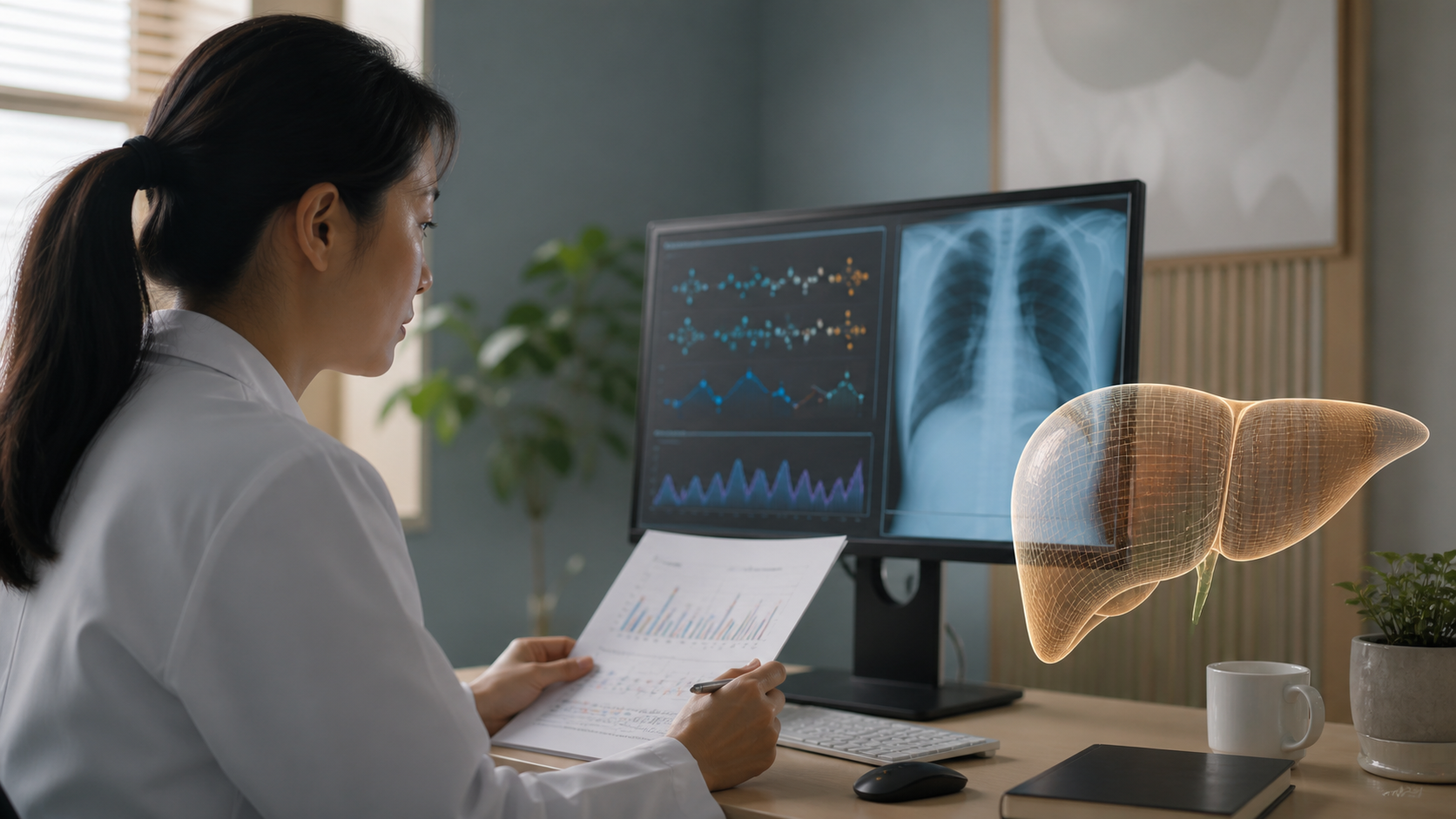
A clinician reviewing routine health data beside a subtle anatomical liver visualization for early disease screening
  • Healthcare & Life Sciences

AI Could Turn Routine Health Data Into an Early Warning for Fatty Liver Disease

  • August 13, 2026
  • No comments
Total
0
Shares
0
0
0
0

Fatty liver disease affects roughly 30 percent of adults worldwide, yet it often develops without obvious symptoms. By the time advanced scarring is discovered, treatment becomes more difficult and risks can include liver failure, cardiovascular disease and cancer. Researchers now see an opportunity for AI to identify warning signs hidden in health data that already exists.

The strongest promise is not a futuristic diagnosis made by a single model. It is a practical screening layer that calculates risk from routine blood work, searches electronic records or notices liver abnormalities in images captured for another purpose. Used carefully, those systems could direct more people toward specialist assessment while the damage may still be reversible.

Existing tests are useful but inconsistently applied

Early-stage liver inflammation and fibrosis can improve through changes including weight loss, exercise and reduced alcohol consumption. Treatments such as semaglutide and resmetirom may also help some people with more advanced scarring. The central problem is finding the condition early enough to act.

Clinicians already have non-invasive tools. The Fib-4 index estimates the risk of advanced fibrosis using age, two liver-enzyme measurements and blood-clotting ability. A second-line enhanced liver fibrosis test measures proteins and an enzyme associated with scar formation and clearance. Using both tests has been reported to improve detection of advanced fibrosis fourfold.

Yet adding manual calculations and testing to overloaded primary-care workflows is difficult. Specialists interviewed by WIRED suggest that software could calculate Fib-4 automatically from routine results and flag the patients most likely to need further examination. That would make AI less a replacement for clinical judgment than a background triage mechanism.

The limitation is that simple scores perform unevenly. Fib-4 can be less accurate for adolescents and older adults, while false positives may generate unnecessary referrals unless the result is combined with other evidence.

Models are searching blood records and incidental images

Electronic health records contain years of visits and laboratory results that could help identify people whose risk has gone unnoticed. Jeffrey Lazarus of the CUNY Graduate School of Public Health and Health Policy argues that AI could retrospectively prioritise likely cases across large hospital populations.

Routine images offer another route. Researchers at Osaka Metropolitan University trained a model to detect fatty liver disease from chest X-rays, which capture part of the liver even when clinicians are primarily examining the lungs and heart. Their study reported 82 percent accuracy. That figure is encouraging, but it does not by itself establish performance across different hospitals, equipment or patient populations.

Blood-based models are also advancing. Danish health technology company Evido developed LiverPRO, which uses age and nine routine biomarkers to assess fibrosis risk. The system, now being commercialised with Roche, reportedly outperformed Fib-4 in data from more than 470,000 middle-aged people.

Another model, ALADDIN, was evaluated by an international hepatology group as a way to identify patients most likely to benefit from resmetirom. Researchers reported better performance than Fib-4 and other risk scores. These systems remain decision-support candidates; they do not eliminate the need for imaging, biopsy or specialist review.

Screening value depends on what happens after a flag

An automated alert is useful only if health systems can confirm the result and offer appropriate care. A model that finds more moderate-risk patients could reduce missed disease, but excessive false positives could move the bottleneck from detection to hepatology clinics.

Deployment therefore requires thresholds tailored to the population, clear referral pathways and monitoring for age or demographic groups where performance changes. Clinicians also need to understand which evidence produced a recommendation rather than receiving an unexplained warning.

Much of the reported AI work in liver care remains research. Its economic appeal is nevertheless substantial: earlier intervention may avoid costly treatment for cirrhosis and transplantation, while giving patients a better chance to reverse damage.

The near-term opportunity lies in using information that health systems already collect but do not consistently connect. If validated in real workflows, AI could make liver screening quieter and more systematic—calculating in the background, identifying overlooked risk and leaving diagnosis and treatment decisions with clinicians who can examine the full patient.


Views: 146
Total
0
Shares
Share 0
Tweet 0
Pin it 0
Share 0
Topics
  • Diagnostics
  • LiverDisease
  • MachineLearning
  • Screening
Previous Article
A clinician reviewing a calm video consultation while three subtle AI layers support conversation, planning and perception
  • Healthcare & Life Sciences

Google’s Video Doctor Experiment Separates Conversation From Clinical Reasoning

  • August 12, 2026
View Post
Next Article
A person reviewing a calm wellness dashboard while a glucose sensor contributes a continuous stream of health data
  • Healthcare & Life Sciences

Google’s AI Health Coach Will Add Continuous Glucose Data—With Medical Limits

  • August 14, 2026
View Post

Stay Ahead of AI

Get the AI developments that matter, delivered to your inbox.

More AI News
AI-generated conceptual illustration of an unbranded autonomous test sedan with a safety operator, not an actual Pony.ai vehicle or operating service
View Post
  • 3 min
  • Autonomous Vehicles

inDrive’s Kazakhstan Robotaxi Plan Begins With a Feasibility Test

  • October 23, 2026
AI-generated fictional gathering of women learning with laptops, not the real Aged Intelligence Society or its founders
View Post
  • 3 min
  • Work & Society

Aged Intelligence Society Makes AI Learning a Shared Exercise

  • October 23, 2026
AI-generated fictional clinician reviewing abstract diagnostic research materials, not a real patient or clinical trial
View Post
  • 3 min
  • Healthcare & Life Sciences

Microsoft’s New Diagnostic Results Face a Real-World Test

  • October 23, 2026
AI-generated conceptual brass key connecting separate cloud compartments, not an actual network diagram
View Post
  • 3 min
  • Cybersecurity

ConnectWise Incident Shows Why AI Attack Counts Need Context

  • October 23, 2026
AI-generated fictional office team reviewing abstract computer output, not actual Uber employees or premises
View Post
  • 3 min
  • Enterprise & Productivity

Uber Expands ChatGPT Work, With Outcomes Still to Be Measured

  • October 23, 2026
AI-generated conceptual collage of a record connected to blank devices, illustrating distribution through AI agents
View Post
  • 3 min
  • Business & Markets

Spotify Bets on AI Agents as a Distribution Channel

  • October 23, 2026
AI-generated conceptual server illustration showing an intrusion trail predating a protective update, not an actual affected system
View Post
  • 3 min
  • Cybersecurity

AWS Finds PHP Attack Attempts Before Public Disclosure

  • October 22, 2026
AI-generated fictional California technology-company boardroom and campus, not Meta's actual premises
View Post
  • 3 min
  • Big Tech Strategy

Meta Links Its Non-Voting Share Plan to Founder Leadership

  • October 22, 2026

Leave a Reply Cancel reply

Your email address will not be published. Required fields are marked *

Subscribe

Subscribe now to our newsletter

AI Updates
  • About
  • Newsletter
  • Contact
  • Privacy Policy
  • Terms of Use
Artificial Intelligence News

Input your search keywords and press Enter.

Go to mobile version







