AI Updates
  • Latest News
  • Models & Research
    • AGI & Alignment
    • AI Agents
    • Foundation Models
    • Generative AI
    • Open Source AI
    • Research & Papers
    • Rankings & Benchmarks
  • Infrastructure
    • Chips & Semiconductors
    • Cloud & Networking
    • Data Centers & Neoclouds
    • Developer Platforms
    • Quantum Computing
  • Business
    • Big Tech Strategy
    • Mergers & Acquisitions
    • Public Markets
    • Startups & Funding
    • Talent & Leadership
    • Market Analysis
  • Applications
    • Consumer & Creative
    • Cybersecurity
    • Education & Media
    • Enterprise & Productivity
    • Finance & Legal
    • Healthcare & Life Sciences
    • Industry & Manufacturing
    • Science & Discovery
  • Robotics
    • Autonomous Vehicles
    • Drones & Defense
    • Edge AI & Embodied Intelligence
    • Robotics
  • Energy
    • Cooling & Water
    • Efficiency & Emissions
    • Electricity & Power Grids
    • Nuclear & Renewables
  • Policy & Society
    • AI Safety & Security
    • Copyright & Misinformation
    • Geopolitics
    • Privacy & Human Rights
    • Regulation & Government
    • Work & Society
Stay Ahead of AI

Get the AI developments that matter, delivered to your inbox.

Follow AI Updates
Facebook
Twitter
Instagram
  • Home
  • About
  • News
  • Contact
  • Newsletter
0
0
0
AI Updates AI Updates
AI Updates
  • Latest News
  • Models & Research
    • AGI & Alignment
    • AI Agents
    • Foundation Models
    • Generative AI
    • Open Source AI
    • Research & Papers
    • Rankings & Benchmarks
  • Infrastructure
    • Chips & Semiconductors
    • Cloud & Networking
    • Data Centers & Neoclouds
    • Developer Platforms
    • Quantum Computing
  • Business
    • Big Tech Strategy
    • Mergers & Acquisitions
    • Public Markets
    • Startups & Funding
    • Talent & Leadership
    • Market Analysis
  • Applications
    • Consumer & Creative
    • Cybersecurity
    • Education & Media
    • Enterprise & Productivity
    • Finance & Legal
    • Healthcare & Life Sciences
    • Industry & Manufacturing
    • Science & Discovery
  • Robotics
    • Autonomous Vehicles
    • Drones & Defense
    • Edge AI & Embodied Intelligence
    • Robotics
  • Energy
    • Cooling & Water
    • Efficiency & Emissions
    • Electricity & Power Grids
    • Nuclear & Renewables
  • Policy & Society
    • AI Safety & Security
    • Copyright & Misinformation
    • Geopolitics
    • Privacy & Human Rights
    • Regulation & Government
    • Work & Society
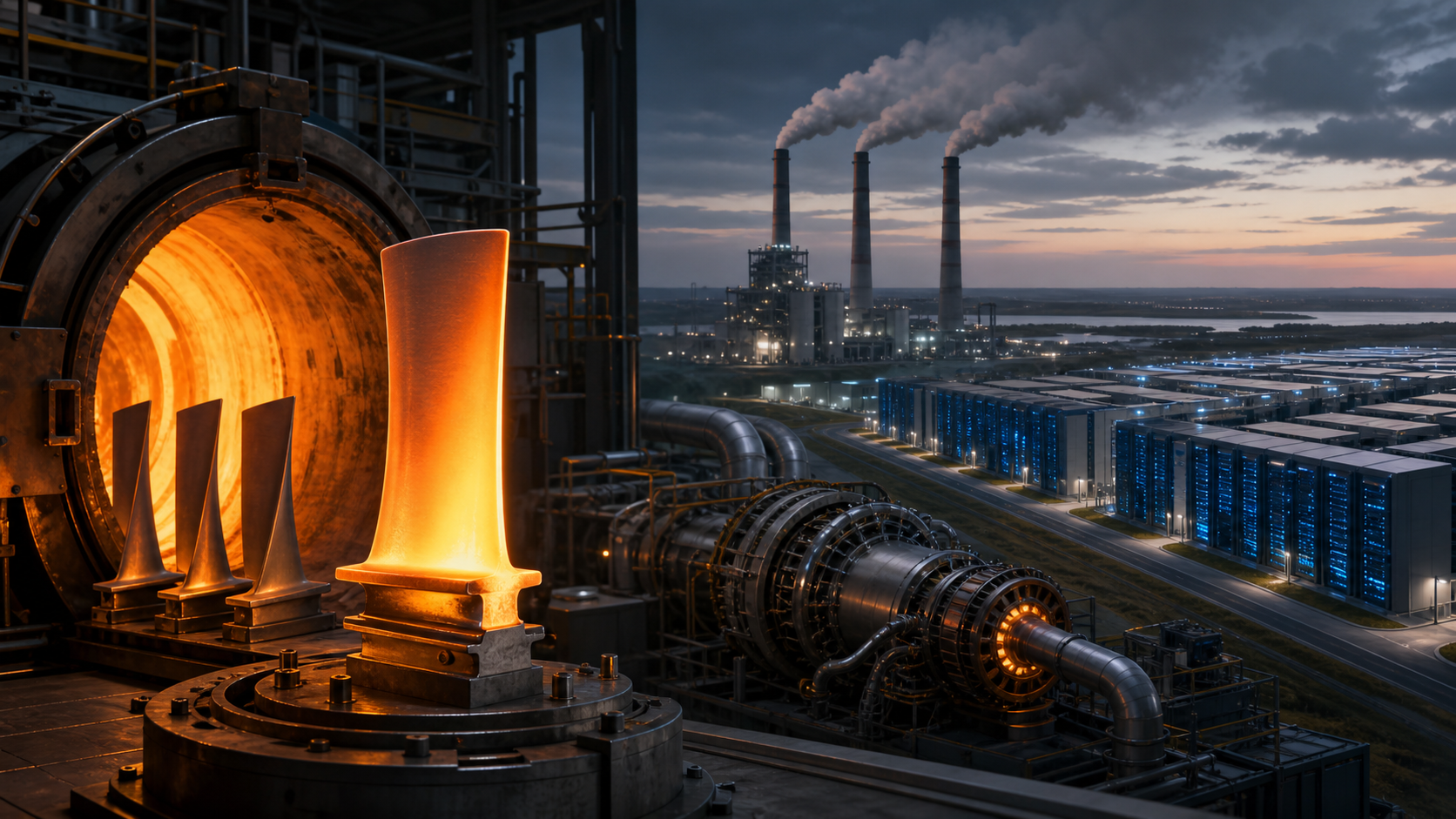
A precision turbine-blade foundry connects to a gas-powered AI data center under a visible pollution plume
  • Energy & Sustainability

SpaceX Targets Gas-Turbine Bottleneck as AI Power Demand Grows

  • August 31, 2026
  • No comments
Total
0
Shares
0
0
0
0

SpaceX is building a foundry in Bastrop, Texas, that Elon Musk says will manufacture blades and vanes for natural-gas turbines, targeting a production bottleneck that is slowing new power capacity for artificial-intelligence data centers.

Musk said in-house casting could bring turbines online as much as 18 months faster. He described natural gas as a temporary supplement and bootstrap for planned solar production, but the strategy would also accelerate a source of air pollution already under legal and scientific scrutiny near data-center sites.

The project highlights how AI infrastructure constraints have moved beyond processors. Data centers need enough electricity to operate large chip clusters, and long grid and equipment timelines are pushing developers toward private gas-fired plants.

Turbine blades become an AI supply constraint

The foundry’s purpose emerged through job listings mentioning blades and vanes and research showing that SpaceX acquired about 830 acres near its Starlink factory in Bastrop between March and June. Musk then confirmed the manufacturing plan on Saturday.

He said SpaceX and Tesla are each building 100 gigawatts of annual solar-production capacity as quickly as possible. Even so, he expects natural gas to remain necessary for several years. According to Musk, casting turbine blades and vanes is the limiting factor in expanding gas-turbine production.

The components are unusually difficult to make. TechCrunch reports that blades in the hottest part of a turbine operate at roughly 3,000 to 3,600 degrees Fahrenheit, around 800 degrees above the melting point of their metal alloy. Internal cooling channels, thermal-barrier coatings and a specialized casting process allow them to survive.

Each blade must be grown as one unbroken crystal inside a vacuum furnace, avoiding microscopic seams that could crack under stress. Power-plant blades are larger than those used in jet engines, increasing the manufacturing challenge. Only four companies worldwide have mastered industrial-scale production, according to the article, and their capacity is booked.

Musk’s claim that internal production can shorten schedules remains a projection. Successfully casting large, defect-free components at scale is technically demanding, and the foundry has not yet demonstrated the stated acceleration.

Private generation bypasses a constrained grid

GPU availability remains a challenge, with Nvidia’s latest Blackwell chips carrying lead times of several months. Electricity has become a parallel constraint. The International Energy Agency projects that global data-center power use will approximately double by 2030, while turbine manufacturer GE Vernova is effectively sold out through 2030, largely because of AI-infrastructure demand.

Private gas plants located beside data centers offer a way to avoid waiting for grid connections. TechCrunch says Amazon, Google, Meta, OpenAI and Microsoft are among the hyperscalers using this approach after previously prioritizing wind and solar.

If SpaceX succeeds, a Musk-controlled company would possess a manufacturing capability on which other infrastructure builders depend. TechCrunch describes that as a potential competitive advantage for SpaceXAI, because a well-funded software company could not quickly reproduce the specialized foundry process.

That advantage would come from controlling a physical supply chain rather than improving a model or chip. The project demonstrates how AI competition is extending into industrial components whose production capacity was not designed for the current build-out.

Faster turbines carry local health costs

More turbine capacity would also mean faster deployment of fossil-fuel generation. In Memphis, where SpaceXAI has used gas turbines for its Colossus data centers since 2024, the NAACP has repeatedly alleged that the company operated equipment without required federal permits or pollution controls.

The organization says the turbines emit smog-forming compounds and hazardous chemicals including formaldehyde, which are associated with asthma, respiratory disease and certain cancers. University of Memphis researchers found pollution became slightly worse because of the data center in what they characterized as a limited analysis.

A separate Virginia study commissioned by the Piedmont Environmental Council used the Environmental Protection Agency’s COBRA health-impact model. It estimated that emissions from eight continuously operating turbines at one facility could affect more than 2.5 million people, cause 3.4 to 6.5 additional premature deaths annually and produce $53 million to $99 million in yearly health damages.

Those estimates concern modeled facilities, not confirmed outcomes from the new Texas foundry. They nevertheless show why manufacturing speed cannot be evaluated separately from where turbines operate and who is exposed.

SpaceX’s plan may loosen a real infrastructure bottleneck. It also risks scaling a power strategy whose local environmental burden is already contested. The decisive question is not only whether blades can be cast faster, but whether accelerated gas deployment can meet AI demand without transferring its costs to nearby communities.

Post Views: 91
Total
0
Shares
Share 0
Tweet 0
Pin it 0
Share 0
Topics
  • AI Data Centers
  • Air Pollution
  • Gas Turbines
  • SpaceX
Previous Article
A large data center beside gas turbines and pipelines under a restrained evening sky
  • Energy & Sustainability

AI Data Centers’ Natural-Gas Bet Could Become a Cost Trap

  • August 14, 2026
View Post
Next Article
Climate conference attendees discuss a nearby data center and electrical infrastructure
  • Energy & Sustainability

AI Data Center Demand Dominates Climate Week, Leaving Other Startups Uneasy

  • September 29, 2026
View Post

Stay Ahead of AI

Get the AI developments that matter, delivered to your inbox.

More AI News
AI-generated conceptual illustration of a glass test chamber separated from an abstract network by a disconnected cable, not actual Anthropic infrastructure
View Post
  • 3 min
  • AI Safety & Security

Anthropic’s Offline Evaluation Shift Leaves a Restart Question

  • October 10, 2026
AI-generated illustrative photograph of anonymous publishing colleagues discussing a blank book dummy, not actual employees of a named publisher
View Post
  • 3 min
  • Work & Society

Publishing’s AI Dispute Needs More Than a Yes-or-No Answer

  • October 10, 2026
AI-generated conceptual still life of a smartphone and two ceramic bowls, one containing unmarked coins, illustrating questions about users and paying customers
View Post
  • 3 min
  • Business & Markets

Olivia Moore’s Consumer AI Outlook Raises a Question: Who Pays?

  • October 9, 2026
AI-generated illustrative photograph of an anonymous civilian researcher examining papers in an archive, not an actual US Army facility or a named person
View Post
  • 3 min
  • Research & Papers

Thread AI’s Army Research Agreement Is Not Yet a Performance Result

  • October 9, 2026
AI-generated illustrative photograph of an anonymous adult designer sketching abstract curves in a studio, not a portrait of Jessica Hische or an image of the Muse logo
View Post
  • 3 min
  • Consumer & Creative

Human-Made AI Branding and the Limits of Client Endorsement

  • October 9, 2026
AI-generated conceptual editorial illustration of a digital workflow passing through a controlled gate with a separate return receipt, without readable text
View Post
  • 3 min
  • AI Agents

SAS Interview Puts the Lifetime of Agent Permissions Under Scrutiny

  • October 9, 2026
AI-generated conceptual editorial illustration of an open rulebook and balanced geometric AI nodes in a civic architectural setting, with no readable text
View Post
  • 3 min
  • Regulation & Government

CFR’s AI Oversight Proposal Puts the Rules for Writing Rules in Focus

  • October 9, 2026
AI-generated editorial illustration in a photographic style of adult learners using laptops in a bright Abu Dhabi-inspired training room, not a photograph of the actual programme
View Post
  • 3 min
  • Education & Media

Abu Dhabi Targets 20,000 Employees With AiNative Training as Capability Becomes the Test

  • October 9, 2026

Leave a Reply Cancel reply

Your email address will not be published. Required fields are marked *

Subscribe

Subscribe now to our newsletter

AI Updates
  • About
  • Newsletter
  • Contact
  • Privacy Policy
  • Terms of Use
Artificial Intelligence News

Input your search keywords and press Enter.

Go to mobile version