AI Updates
  • Latest News
  • Models & Research
    • AGI & Alignment
    • AI Agents
    • Foundation Models
    • Generative AI
    • Open Source AI
    • Research & Papers
    • Rankings & Benchmarks
  • Infrastructure
    • Chips & Semiconductors
    • Cloud & Networking
    • Data Centers & Neoclouds
    • Developer Platforms
    • Quantum Computing
  • Business
    • Big Tech Strategy
    • Mergers & Acquisitions
    • Public Markets
    • Startups & Funding
    • Talent & Leadership
    • Market Analysis
  • Applications
    • Consumer & Creative
    • Cybersecurity
    • Education & Media
    • Enterprise & Productivity
    • Finance & Legal
    • Healthcare & Life Sciences
    • Industry & Manufacturing
    • Science & Discovery
  • Robotics
    • Autonomous Vehicles
    • Drones & Defense
    • Edge AI & Embodied Intelligence
    • Robotics
  • Energy
    • Cooling & Water
    • Efficiency & Emissions
    • Electricity & Power Grids
    • Nuclear & Renewables
  • Policy & Society
    • AI Safety & Security
    • Copyright & Misinformation
    • Geopolitics
    • Privacy & Human Rights
    • Regulation & Government
    • Work & Society
Stay Ahead of AI

Get the AI developments that matter, delivered to your inbox.

Follow AI Updates
Facebook
Twitter
Instagram
  • Home
  • About
  • News
  • Contact
  • Newsletter
0
0
0
AI Updates AI Updates
AI Updates
  • Latest News
  • Models & Research
    • AGI & Alignment
    • AI Agents
    • Foundation Models
    • Generative AI
    • Open Source AI
    • Research & Papers
    • Rankings & Benchmarks
  • Infrastructure
    • Chips & Semiconductors
    • Cloud & Networking
    • Data Centers & Neoclouds
    • Developer Platforms
    • Quantum Computing
  • Business
    • Big Tech Strategy
    • Mergers & Acquisitions
    • Public Markets
    • Startups & Funding
    • Talent & Leadership
    • Market Analysis
  • Applications
    • Consumer & Creative
    • Cybersecurity
    • Education & Media
    • Enterprise & Productivity
    • Finance & Legal
    • Healthcare & Life Sciences
    • Industry & Manufacturing
    • Science & Discovery
  • Robotics
    • Autonomous Vehicles
    • Drones & Defense
    • Edge AI & Embodied Intelligence
    • Robotics
  • Energy
    • Cooling & Water
    • Efficiency & Emissions
    • Electricity & Power Grids
    • Nuclear & Renewables
  • Policy & Society
    • AI Safety & Security
    • Copyright & Misinformation
    • Geopolitics
    • Privacy & Human Rights
    • Regulation & Government
    • Work & Society
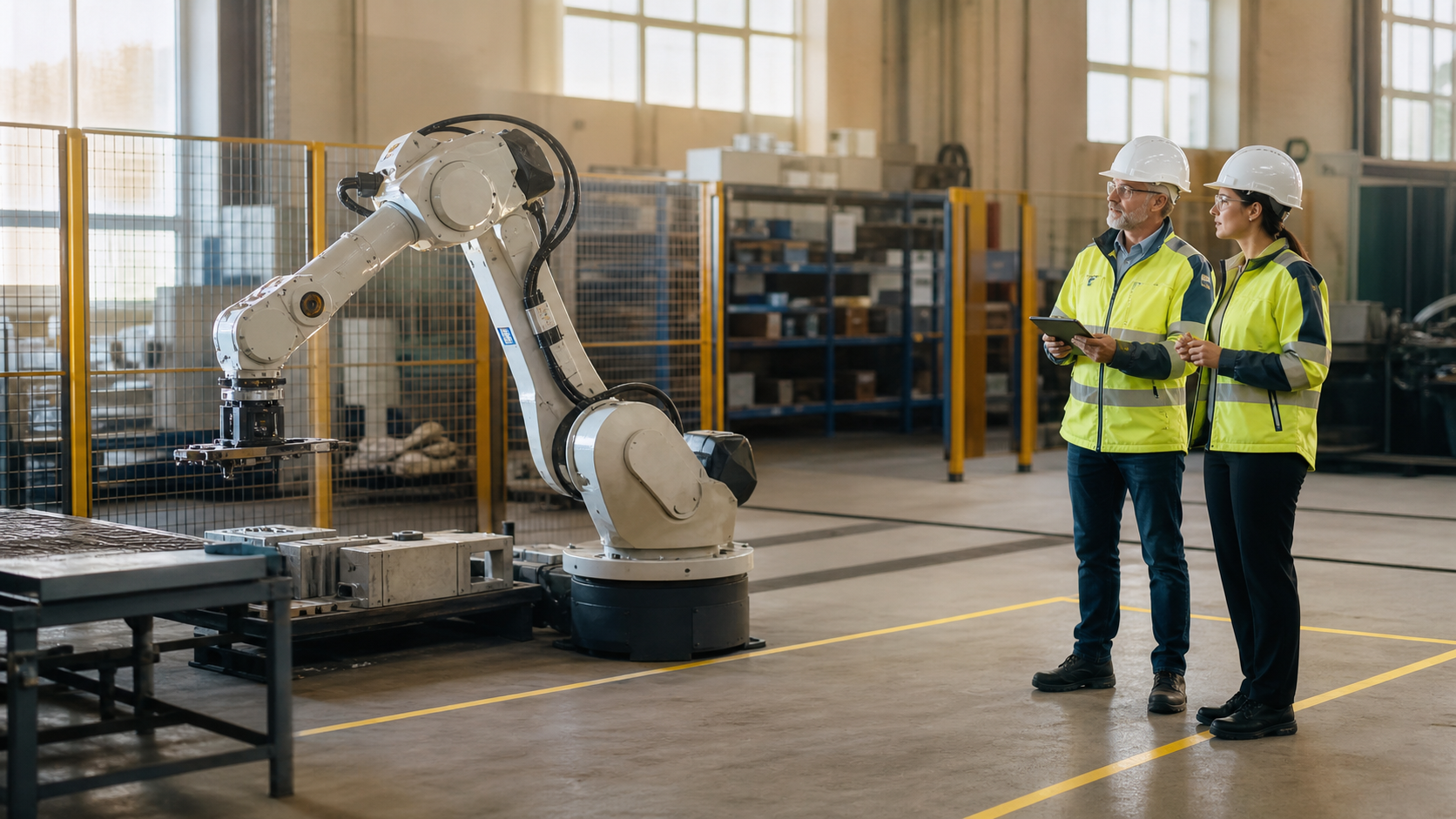
Industrial robot operating inside a clearly bounded safety zone beside human workers
  • Robotics & Autonomy

Physical AI Turns Governance Into a Real-World Safety System

  • May 4, 2026
  • No comments
Total
0
Shares
0
0
0
0

Physical AI changes the meaning of an AI mistake. A flawed answer in a chatbot may inconvenience a user; a flawed instruction sent to a robot can move machinery, damage equipment or place a person at risk.

That distinction is becoming more important as intelligence moves into factories, warehouses and other physical environments. The International Federation of Robotics recorded 542,000 industrial robot installations worldwide in 2024 and expects annual installations to exceed 700,000 by 2028.

The scale of deployment makes governance an engineering requirement rather than a policy document. Every autonomous system needs defined limits on what it can perceive, decide and physically execute.

Model outputs become real-world actions

Google DeepMind’s Gemini Robotics work illustrates the expanding stack behind embodied intelligence. Gemini Robotics is designed as a vision-language-action model that can control robots, while Gemini Robotics-ER focuses on spatial reasoning, planning and understanding whether a task has succeeded.

A useful robot must do more than recognise an object. It must interpret an instruction, locate relevant items, plan a sequence of movements and decide whether the result is correct. If a step fails, the system must know whether to retry, request help or stop.

Those decisions connect probabilistic model behaviour with mechanical systems. Generality helps robots handle unfamiliar settings, interactivity lets them respond to people and changing conditions, and dexterity enables precise manipulation. Each capability also creates a new failure surface.

Physical limits therefore matter as much as model evaluations. Collision avoidance, force constraints and stability controls can prevent dangerous movements even when higher-level reasoning goes wrong. Semantic safety adds another layer: the system must recognise when a seemingly simple request is unsafe in context.

Governance must reach the entire machine

Traditional software controls still apply. Organisations need to define which data a system can access, which tools it can call, how actions are logged and where human approval is mandatory. In Physical AI, those controls extend through sensors, models, software and actuators into the operating environment.

Least-privilege access should govern both information and movement. A maintenance robot may be permitted to inspect an instrument but not change its settings. A warehouse system may move approved packages inside a marked zone while refusing tasks outside it.

Clear escalation paths are equally important. Success detection cannot be treated as a convenience feature when an incorrect assessment might cause a robot to repeat a dangerous action. Uncertainty should trigger a safe state, not improvisation.

Google DeepMind’s ASIMOV dataset, created to evaluate semantic safety in robotics, reflects the need to test whether systems understand safety-related instructions. Frameworks such as the NIST AI Risk Management Framework and ISO/IEC 42001 can support organisational accountability, but their controls must be translated into the specific mechanics of each deployment.

Deployment should begin with bounded autonomy

The most credible route to scale is to start with constrained tasks in controlled environments. Industrial inspection, material movement and repetitive handling offer measurable outcomes and established safety practices. They also make it easier to identify where a model ends and conventional automation should take over.

Teams should test unfamiliar objects, ambiguous instructions, sensor failure and unexpected human presence before production. Logs must connect every physical action to the instruction, data and model decision that produced it. Emergency stops need to work independently of the AI stack.

Governance also requires named ownership. Model developers, robotics engineers, security teams and site operators may each control a different layer, but the organisation still needs one accountable process for approving changes and investigating incidents.

Physical AI could make machines more adaptable and useful across manufacturing, logistics and facilities. Its value will depend less on impressive demonstrations than on reliable behaviour over thousands of ordinary interactions.

The central governance question is not whether a robot can complete a task. It is whether the organisation can predict its authority, observe its actions and stop it safely when conditions move beyond the boundaries it was designed to handle.

Post Views: 109
Total
0
Shares
Share 0
Tweet 0
Pin it 0
Share 0
Topics
  • Autonomy
  • Gemini
  • Governance
  • Robotics
  • Safety
Previous Article
Home robot, vehicle system and cooled AI infrastructure connected through one physical AI stack
  • Robotics & Autonomy

LG and Nvidia Talks Expose Physical AI’s Hidden Dependencies

  • April 30, 2026
View Post
Next Article
Robotics engineers observing a practical autonomous machine demonstration in a bright expo hall
  • Robotics & Autonomy

San Jose Physical AI Expo Targets the Leap From Prototype to Production

  • May 13, 2026
View Post

Stay Ahead of AI

Get the AI developments that matter, delivered to your inbox.

More AI News
Illustrative photograph of an unbranded compact sedan in an empty parking lot with cameras and an attentive adult safety observer, representing supervised driving research
View Post
  • 3 min
  • Autonomous Vehicles

AI Driving Experiment Shows Physical Control While a Parking-Lot Test Reveals Limits

  • October 7, 2026
Illustrative scene of a fictional adolescent talking with an adult caregiver at a kitchen table with a phone set aside, representing human support beyond a chatbot
View Post
  • 3 min
  • AI Safety & Security

Teen Chatbot Safety Study Questions Engagement Cues as OpenAI Disputes Its Methods

  • October 7, 2026
Conceptual illustration of an ordinary-looking message card linked to a shadowy doorway behind a protective screen, representing checks on concealed harmful destinations
View Post
  • 3 min
  • AI Safety & Security

Meta Targets Hidden Abuse Links as Its Enforcement Figures Leave Detection Limits Unclear

  • October 7, 2026
Editorial collage of an unmarked filmstrip over closed document folders with an abstract defense-institution silhouette, representing video-based procurement and oversight
View Post
  • 3 min
  • Drones & Defense

Pentagon’s Short-Video AI Procurement Push Raises Questions About Spending Visibility

  • October 7, 2026
Illustrative photograph of a fictional healthcare professional reviewing a tablet at a quiet hospital workstation, representing human review of AI screening flags
View Post
  • 3 min
  • Startups & Funding

Healthleap Raises $38 Million to Expand AI Screening That Supports Hospital Review

  • October 7, 2026
Conceptual illustration of two architectural forms linked by an unfinished bridge and a blank open document, representing a framework for rights-based AI cooperation
View Post
  • 3 min
  • Privacy & Human Rights

Council of Europe and Microsoft Set a Rights-Based Framework for AI Cooperation

  • October 7, 2026
Editorial illustration of a creative studio desk with abstract image panels and a film strip emerging from a simple light source, representing a startup pivot into AI-generated campaign assets
View Post
  • 3 min
  • Startups & Funding

Melius Raises a $20 Million Series A After Rebuilding Its Advertising AI Business

  • October 7, 2026
Conceptual photograph of a clean data-center aisle with server cabinets and a concentrated warm light at the far end, representing infrastructure growth and concentrated demand
View Post
  • 3 min
  • Data Centers & Neoclouds

Lambda Seeks Up to $4 Billion as Its IPO Plans Meet a Concentrated Backlog

  • October 7, 2026

Leave a Reply Cancel reply

Your email address will not be published. Required fields are marked *

Subscribe

Subscribe now to our newsletter

AI Updates
  • About
  • Newsletter
  • Contact
  • Privacy Policy
  • Terms of Use
Artificial Intelligence News

Input your search keywords and press Enter.

Go to mobile version