

AI drug discovery is often described as a model race, but GSK’s new collaboration with Relation Therapeutics places a different asset at the centre: purpose-built biological data. The agreement, potentially worth up to $110 million, will fund experiments measuring how human cells respond to genetic changes and drug interventions, with the results used to train target-discovery models.
The partnership expands earlier work on fibrotic disease and osteoarthritis. It also illustrates a broader industry shift. When public datasets are noisy, duplicated or poorly matched to a disease, generating new experimental evidence can matter as much as building a larger algorithm.
The laboratory becomes part of the learning loop
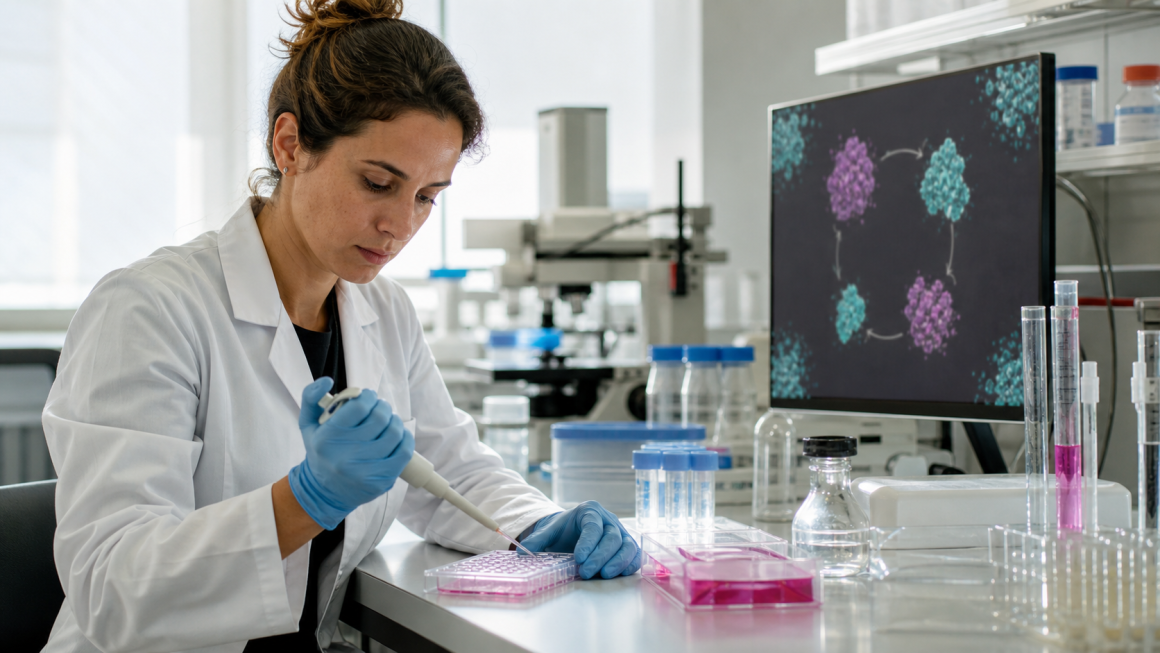
Relation calls its approach Lab-in-the-Loop. Laboratory work—including tissue profiling, single-cell and spatial transcriptomics, sequencing and functional assays—produces observations that computational systems can analyse. Machine learning then helps identify targets, prioritise candidates and design the next experiment.
Perturbation studies are particularly relevant. Researchers change genes or apply interventions and measure the resulting cellular characteristics. That provides information about biological response rather than correlation alone, giving models a stronger basis for proposing targets that can later be validated.
The new collaboration will train models within Relation’s MORGAN platform, according to the source. The companies have not disclosed which diseases the new programme will prioritise, how performance will be assessed or how the agreement’s potential value is divided between upfront and milestone payments. The $110 million figure should therefore be read as a maximum deal value, not guaranteed revenue.
Earlier projects combined human genetics, patient tissue, single-cell multi-omics, functional assays and machine learning. Relation’s Osteomics programme applies a similar strategy to bone disease, combining patient-derived samples with imaging, genomics, proteomics and clinical phenotype data.
More cells do not automatically produce a better model
Public repositories remain indispensable. A 2025 review cited in the source noted that CZ CELLxGENE alone provides more than 100 million standardised cells, alongside resources such as the Human Cell Atlas and NCBI Gene Expression Omnibus.
Scale brings complications. Studies can use different sampling methods, sequencing protocols and processing pipelines. Technical noise and batch effects may obscure biological signal, while overlapping cells across repositories can distort training and leak information between training and test sets.
Recent research also challenges a simple scaling assumption. A Nature Methods study trained 400 models across 6,400 experiments using a corpus of 22.2 million cells. The single-cell foundation models tended to plateau after seeing only part of the available data rather than improving consistently as the corpus grew.
Another evaluation of Geneformer and scGPT found that the foundation models did not consistently beat simpler methods on several zero-shot tasks. Neither result proves that small or proprietary datasets are inherently superior. They show that model capacity, data diversity, experimental quality and compute must be balanced—and that more observations can add redundancy rather than knowledge.
Specialised datasets are becoming strategic assets
Pharmaceutical collaborations increasingly combine platform access with data licensing or new data generation. The source cites GSK’s separate $37.5 million agreement with Ochre Bio involving human liver data, and a $200 million AstraZeneca–Pathos AI arrangement with Tempus covering de-identified clinical, genomic and imaging data from more than 150,000 patients.
These figures demonstrate commercial interest, not clinical success. A target predicted from a rich dataset still needs biological validation, drug development and trials. Proprietary data can also be difficult for outsiders to reproduce or independently benchmark.
For GSK and Relation, the practical test will be whether the combined workflow identifies targets that survive experimental challenge better or faster than existing approaches. Useful evidence would include prospective validation rates, performance on unseen patient samples and transparent comparisons with simpler baselines.
The collaboration makes a credible point: in biological AI, the experiment is not merely a source of training material but part of the product. Competitive advantage may come from choosing what to measure, controlling how it is measured and closing the loop between prediction and evidence—not simply accumulating the largest possible collection of cells.