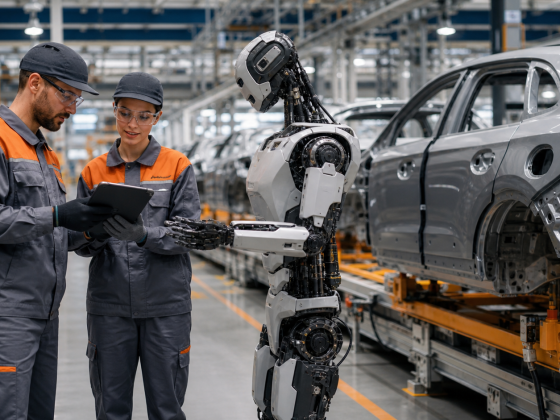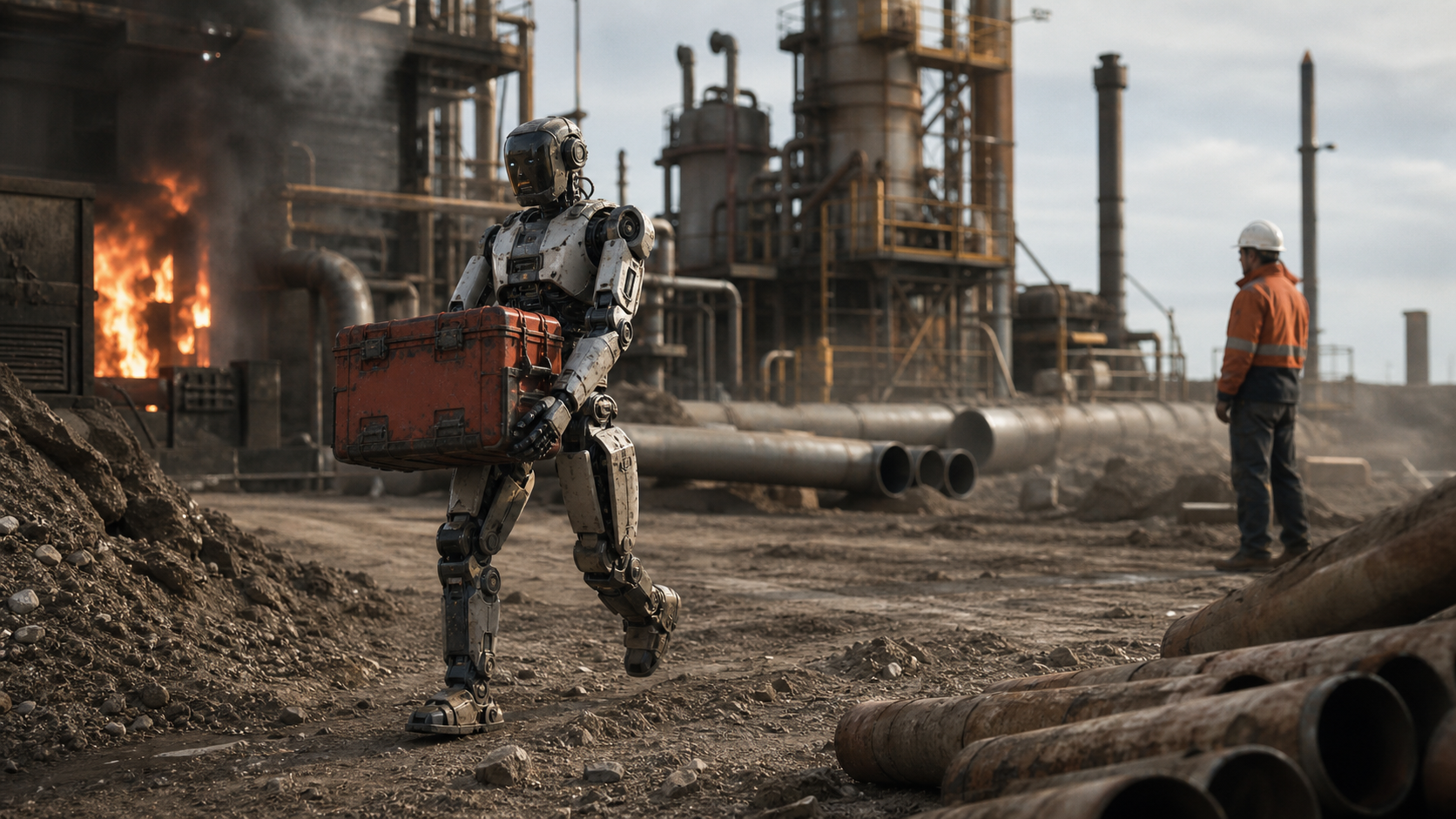
Industrial sites still rely on people for work that combines mobility, judgement and physical strength. Those same tasks often expose workers to dust, heat, vibration and heavy loads, making them attractive targets for a new generation of general-purpose robots.
ADLINK Technology and Under Control Robotics, the company behind Noble Machines, have signed an alliance and joint-development agreement to build bipedal, bimanual systems for demanding environments. The partnership combines ADLINK’s rugged edge-computing hardware with Noble Machines’ perception, autonomy and whole-body control software.
Initial markets include manufacturing, mining, construction, energy, petrochemicals and public utilities. Each faces labour shortages, but the more important common feature is that existing workplaces were designed around human movement rather than fixed automation.
Rugged edge computing supports real-time control
ADLINK’s DLAP platform is built on Nvidia Jetson Thor and is designed to operate where a conventional computer may struggle. The companies cite multiple voltage inputs, as many as eight GMSL camera connections, four Ethernet ports and optional 5G or Wi-Fi connectivity.
The hardware supports a broad temperature range and complies with IEC 60068 requirements for shock and vibration. These details are less dramatic than a humanoid demonstration, but they determine whether a machine continues functioning beside heavy equipment or in a dusty construction area.
Processing at the edge is also essential for control. A robot balancing, carrying a load or responding to a moving person cannot wait for a distant cloud service. Cameras and other sensors produce continuous data that must become coordinated movement in real time.
Noble Machines provides the software that interprets those inputs and controls the robot’s complete body. The objective is not merely walking or grasping in isolation, but combining both while the environment changes.
Human-shaped machines fit human workplaces
Traditional industrial robots deliver speed and precision in tightly structured cells. Retrofitting a mine, utility site or construction project around them can be impractical. A bipedal, two-armed robot could use stairs, tools and access routes already created for people.
That compatibility explains the focus on a human-like form. It does not mean the robot must imitate every human capability. A useful deployment may begin with a narrow set of inspections, material movements or repetitive operations performed under supervision.
Construction and energy are likely early targets because many tasks combine risk with unpredictable conditions. Hard-coded automation would require engineers to anticipate every object position and interruption. Physical AI can use perception and reasoning to choose among actions when the situation differs from a predefined script.
The companies also want a more turnkey product. Customers may be reluctant to integrate experimental hardware, autonomy software, sensors and supply-chain support from separate providers. A jointly developed platform can reduce that burden and give one system-level route for maintenance and validation.
Safety will determine commercial credibility
The same adaptability that makes general-purpose robots useful makes them difficult to certify. A large mobile machine operating near workers must respond correctly to unfamiliar events without losing balance, dropping a load or disrupting the wider site.
Successful pilots need explicit operating boundaries, safe-stop behaviour and clear human authority. Performance should be measured not only by completed tasks but also by interventions, near misses, recovery time and the conditions in which the robot declines to act.
Durability creates another economic test. A machine that works in a laboratory but needs frequent attention in heat or vibration may be less valuable than simpler equipment. ADLINK’s industrial hardware experience addresses part of that problem, while Noble Machines must show that autonomy remains stable when sensors are dirty or visibility changes.
The partnership represents a practical division of labour in physical AI. One company supplies a robust computing and connectivity foundation; the other supplies coordinated movement and decision-making. Neither is sufficient alone.
Replacing people in dangerous settings is a compelling goal, but it will not be achieved by appearance or one impressive demonstration. Industrial customers will judge these robots by predictable operation, repairability and evidence that risk has genuinely moved away from workers rather than taken a new form. If ADLINK and Noble Machines can meet that standard, humanoid design may become less a technological spectacle and more a useful way to automate workplaces that were never built for robots.